
A simpler way to ship with Phoenix
Parcel shipping should be the last smooth step in fulfillment. Too often, it becomes the most fragmented: one system chooses a carton, another compares rates, a carrier portal creates the label, and a spreadsheet tries to explain the invoice after the parcel is gone.
At JASCI Software, we created Phoenix to bring that work into a single AI-native WMS. Carrier accounts, service rules, cartonization, packing, rate shopping, label generation, tracking, delivery performance, and spend analytics operate from the same data and the same execution flow. Instead of asking a packer to remember which service to use, Phoenix can apply the policy consistently to every eligible shipment, and then retain the context needed to explain the choice later.
The result is a simpler operating model. Teams connect carriers once, define how the business wants shipments routed, guide workers from scan to label, and then use actual shipping and delivery data to improve the rules. Savings are no longer a one-time carrier-negotiation project. They become part of a continuous loop.
What Are the 3 Pillars of Modern Parcel Shipping
At JASCI, we built Phoenix as an AI-native WMS for the workflow shown throughout this article. Its parcel-shipping capabilities are built into the warehouse workflow rather than treated as an isolated shipping utility. That distinction matters because the best shipping decision depends on information the warehouse already knows: order contents, product dimensions, destination, channel, service promise, carton options, carrier credentials, cutoff exposure, and the work taking place at the bench.
Configure once, execute at the bench, and optimize continuously. The parcel workflow is built into the WMS rather than added as a disconnected shipping module.
Configure
Register carriers, connect API credentials, and author priority rules that filter and rank services at rate-shop time, including an AI assistant that drafts rules in plain English.
Carriers + Shipping RulesExecute
Pack Station guides operators from tote scan to the cartonized box, multi-carrier rate comparison, and label print. Rate Shop gives supervisors a side-by-side carrier bench for testing.
Cartonize + Pack + Rate ShopOptimize
Shipping Savings quantifies dollars left on the table and supports carrier invoice review. Shipping Delivery scores carriers on promised versus actual transit using your own delivery data.
Savings + DeliveryThis is the practical meaning of AI-native shipping: AI is connected to the configuration and operating context, while deterministic business rules, user permissions, and auditable outcomes keep the workflow controlled. A supervisor can describe a policy in plain language, test it, and promote it; the platform can then apply the approved rule during rate shopping and record why it fired.
How Phoenix Powers Parcel Shipping
From carrier setup to measurable savings
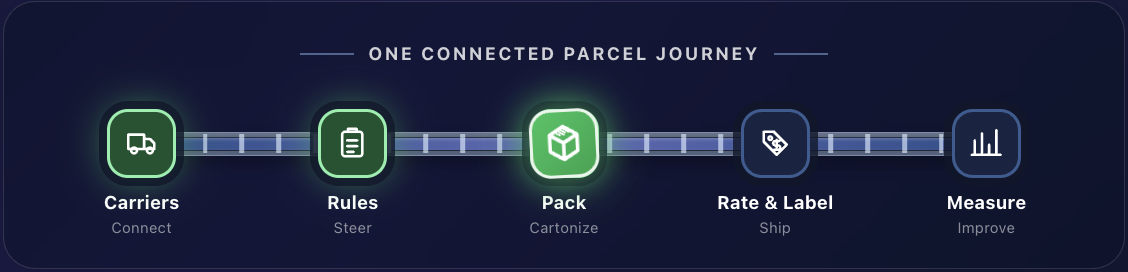
The parcel workflow is one connected sequence: configure carriers, containers, and rules; pack and rate at the bench; ship with confidence; then tune decisions with real savings and delivery data.
Because Phoenix is an AI-native WMS, its intelligence can work from the same live order, carton, carrier, and performance context that drives execution, helping teams improve decisions without separating AI from the warehouse workflow.
1. Carriers
Master data + API credentials
2. Rules
Filter, rank, steer carriers
3. Pack
Cartonize, scan, weigh
4. Rate & Label
Multi-carrier shop + print
5. Measure
Savings + delivery scorecards
1. Connect carriers once
Carrier Maintenance provides a common registry for parcel, regional, postal, marketplace, and aggregator connections. Operations teams can select a supported carrier record, store the appropriate account credentials, enable it for the relevant fulfillment center, and manage service-level details from one place. Pack Station, Rate Shop, and shipping rules then reference that shared setup.

- Choose a supported parcel, regional, postal, marketplace, or aggregator carrier connector.
- Store account credentials and enable the appropriate services for each fulfillment center.
- Maintain the setup once so Pack Station, Rate Shop, and shipping rules share the same carrier data.
2. Turn shipping policy into reusable rules
Priority-ordered rules define which services are eligible and how they should be ranked. A rule can evaluate shipment facts such as weight, destination, sales channel, residential status, quoted charge, or transit time. It can then choose the cheapest, fastest, or best-value option; prefer a carrier; or exclude a service that does not fit the promise.
Phoenix adds an AI-assisted builder to this process. A user can describe the desired policy in plain English, review the proposed logic, preflight it against recent shipment scenarios, and activate it after approval. This shortens the distance between an operating decision and an executable rule while keeping a human in control of what goes live.

- Set conditions using weight, destination, channel, residential status, quoted charge, or transit time.
- Choose actions such as cheapest, fastest, or best value, or pin and exclude specific carriers and services.
- Use the AI Builder to describe a rule in plain English, preflight it against recent shipments, and promote the approved rule to active.

3. Choose the right-size carton before buying a label
Phoenix evaluates each order against a maintained catalog of shippable containers—including height, width, length, maximum weight, material, and use code—to select the lowest-cost eligible fit and tell the operator which box or mailer to use in Pack Station before rate shopping and label generation.
That sequence is important because carriers may price a parcel using dimensional weight when its volume is high relative to its actual weight. Both UPS and FedEx explain that package dimensions can affect billable weight. Right-sizing the carton reduces the chance of paying to ship unused space while also reducing excess packaging material.

4. Compare eligible carrier services in real time
Rate Shop sends the shipment facts to enabled carriers and returns comparable quotes. The approved rules narrow or rank the choices so the operator can focus on services that meet the business objective. The same engine can also be used as a standalone supervisor bench for validating a new account, testing service availability, or training a team without occupying a live pack station.
A supervisor can enter the parcel weight, residential flag, and a Cheapest, Fastest, or Best Value strategy, then review a ranked table of live quotes from every enabled carrier with carrier-specific errors surfaced in the same view. After a rate is selected, Phoenix purchases the label and returns the tracking number immediately; the same carrier-agnostic shop can validate accounts and rule behavior off-bench before Pack Station runs it in the live shipping flow.

5. Move from scan to label in one guided session
Pack Station brings item verification, the carton recommendation, package weight, rate shopping, label purchase, and confirmation into one flow. The operator can scan an LPN or tote, validate contents, use the recommended package, capture the weight, and print the selected carrier label without rekeying the order in another system. Exception paths can handle shorts, incorrect items, damage, voids, and re-ships while preserving shipment context.

6. Close the loop with shipment data
After the label prints, the shipping decision becomes measurable. Phoenix can compare the selected rate with eligible alternatives, bring invoice variances into view, and compare a carrier's promised transit with observed delivery performance. Those results give operations and finance a shared record for improving policy, auditing charges, and holding carriers accountable.
AI-Native Parcel Shipping Use Cases
Because Phoenix is an AI-native WMS, it can use shared operational context to support different channels, clients, facilities, and carrier conditions while keeping approved business rules in control.
High-volume ecommerce and D2C
Automate decisions across thousands of residential parcels while protecting order cutoffs and promised delivery dates.
Third-party logistics providers
Apply client-specific shipping rules, use aggregated carrier relationships, and support configurable shipment markups where contracts allow.
Omnichannel fulfillment
Handle marketplace, retail, wholesale, and direct orders from one parcel engine while adapting rules by channel and customer commitment.
Mixed national and regional carrier networks
Compare major carriers with postal, regional, marketplace, or aggregator services according to site and destination coverage.
Peak-season operations
Update priorities quickly when capacity, surcharges, cutoffs, or service reliability change—then apply the approved policy consistently.
Freight-audit and carrier management
Compare invoiced charges with rated shipment context and use delivery scorecards to support carrier reviews and contract discussions.
For sites transitioning from an established workflow, Phoenix can also support a phased operating model. Experienced operators can continue with a familiar pack-and-ship workbench while the organization moves stations or facilities to the newer guided Pack Station experience. Both paths can use the same underlying carrier setup and shipping data.
Smarter Shipping ROI
Parcel ROI is strongest when it is measured as a portfolio of improvements rather than a single discount percentage. The value can come from better carrier and service selection, lower dimensional-weight exposure, faster pack labor, fewer data-entry errors, recovered invoice variances, lower packaging use, and improved on-time performance.
On our parcel-shipping page, we report average shipping-cost reductions of 15–30% through rate shopping and cartonization, along with 50% faster label generation versus standalone systems. These are JASCI-reported directional benchmarks, not a guarantee. A customer's result depends on shipment mix, existing contracts and process maturity, so the business case should begin with its own baseline.
| Value lever | Baseline to capture | How Phoenix helps measure it |
|---|---|---|
| Carrier and service selection | Spend, parcel count, selected service, eligible alternatives | Rate-shop history and savings-left-on-the-table analysis |
| Carton efficiency | Carton used, product cube, DIM/actual billed weight, material cost | Container catalog, carton recommendation, and shipment cost |
| Pack labor | Seconds from pack start to label, touches, exceptions, parcels per labor hour | Workflow timestamps and labor/process reporting |
| Invoice accuracy | Quoted cost, invoiced cost, accessorials, recoveries | Shipment-level variance detail and supporting context |
| Delivery performance | Promised and actual delivery, late rate, customer contacts, reships | Carrier and service scorecards built from tracking actuals |

ROI should be validated with customer-specific data and contract terms. Dashboard values shown are illustrative and should not be interpreted as audited customer results.
Legacy WMS Shipping Gaps
Legacy parcel shipping often grew one carrier, portal, and local workaround at a time. That may keep labels moving, but it makes cost control and process improvement harder as volume and complexity rise.
Many legacy shipping stacks were designed around separate applications, batch integrations, and hard-coded workflows. They can still produce labels, but changing a carrier policy or responding to a new fulfillment requirement often introduces extra handoffs, manual lookups, and reconciliation work. When order, carton, rate, invoice, and delivery data live in different places, teams spend more time assembling the full story and have fewer opportunities to improve a shipment while it is still in motion.
With Phoenix, our AI-native architecture provides a more connected approach. The platform uses shared operational data to move the parcel from carton selection through rate shopping, label generation, and performance analysis, helping teams make faster and more consistent decisions without relying on a patchwork of tools.
| The Previous Way | The Phoenix Way |
|---|---|
| Separate carrier portals and logins | One carrier registry and a common rate-shopping workflow |
| Packer chooses from memory or a wall chart | Priority-ordered rules apply approved policy to shipment facts |
| Box selection based on habit | Cartonization recommends the smallest eligible container |
| Order details rekeyed to create labels | Order, package, rate, label, and tracking data stay connected |
| Lowest rate considered without full promise context | Cost, transit, destination, channel, and business constraints can work together |
| Carrier errors discovered one portal at a time | Carrier-level responses surface in a shared comparison |
| Invoices sampled manually after the fact | Quoted and billed charges can be reviewed with shipment context |
| Carrier reviews rely on anecdotes | Promised-versus-actual delivery is visible by carrier and service |
| Every policy change becomes an IT project | Authorized users can draft, test, approve, and prioritize configurable rules |
The operational cost of fragmentation is not only the extra click. It is the inability to apply policy consistently, explain why a choice was made, learn from the result, and change the process without creating another exception. Phoenix replaces that patchwork with a single decision and execution loop.
Why Parcel Shippers Choose Phoenix
Phoenix brings the decisions, work, and data behind parcel shipping into one connected workflow. The result is a more cost-aware process at the bench, with clearer choices before shipment and better visibility after delivery.

An AI-native platform also reduces handoff friction between teams. Warehouse operations sees the work at the bench. Transportation sees carrier selection and delivery performance. Finance sees quoted charges and invoice variances. Customer service sees tracking context. Leaders can discuss one set of facts instead of reconciling several versions of the shipment.
Lower freight cost
Rules steer each parcel to the right service level, while Shipping Savings shows what the operation recovered.
Faster pack bench
Operators move from scan to label in one session without switching to a carrier portal or re-entering rates manually.
Explainable choices
A decision trace shows which rule selected a carrier and which alternatives were filtered out.
Invoice audit
Carrier bills can be imported and potential overcharges flagged against quoted rates with full parcel context.
On-time accountability
Carrier performance can be scored against promised versus actual transit using the operation’s delivery data.
AI-assisted rules
Teams can describe policy in plain English and preflight it before go-live, without requiring a consultant for every change.
Frequently asked questions
What is a parcel shipping system inside a WMS?
It is software that manages packing, carton selection, carrier connectivity, rate shopping, label generation, shipment confirmation, tracking, and analytics using the order and inventory context already available in the warehouse platform.
How does Phoenix make parcel shipping less expensive?
Phoenix can compare eligible contracted services, apply routing rules consistently, recommend a right-size carton, show savings opportunities, and review invoice variances. Each lever addresses a different source of avoidable cost.
How does Phoenix make the pack process faster?
The operator can verify items, use the recommended container, capture weight, compare eligible services, print the label, and confirm the shipment in one guided session. That reduces portal switching and repeated data entry.
Does AI choose the carrier without human control?
AI can help draft and test shipping rules, but the business remains in control of what is approved and active. During execution, approved rules and shipment data determine eligibility and ranking, and a decision trace can explain the outcome.
What is cartonization, and why does it matter?
Cartonization matches the order to an eligible box or mailer based on item and container characteristics. A better fit can reduce packaging waste and dimensional-weight exposure because parcel pricing may depend on package volume as well as actual weight.
Which carriers can we connect to?
We list integrations across major, postal, regional, international, marketplace, and aggregator options, including UPS, FedEx, USPS, Amazon, DHL, OnTrac, Canada Post, Asendia, and others. Confirm exact services and account requirements for each country and implementation.
Can supervisors test rates without using a live pack station?
Yes. The standalone Rate Shop workbench can validate carrier accounts, compare representative parcels, surface carrier errors, and test how rules narrow or rank services.
Can an operation transition gradually?
Yes. Phoenix supports both the modern Pack Station and a familiar pack-and-ship workbench. A phased rollout can preserve operator continuity while sharing carrier and shipment data underneath.
How should a company measure parcel-shipping ROI?
Start with its own shipment and invoice baseline. Track realized freight improvement, labor time per parcel, packaging use, invoice recoveries, delivery performance, and the fully loaded solution cost. Separate eligible, controllable spend from customer-mandated or fixed shipments.
Do we support 3PL parcel operations?
Yes. We support client-specific workflows and configurable parcel upcharges for 3PLs. The exact billing and markup approach should match customer contracts and applicable requirements.
Make every shipment a better decision.
See how Phoenix, our AI-native WMS, connects carriers, cartons, rules, pack execution, and analytics in one parcel-shipping workflow.
Schedule a JASCI demo