AI-Driven WarehouseConfiguration & Execution
The first WMS that turns implementation from a 6-12 month project into a guided, validated setup process your operations team can run in days or weeks.
What is AI-Driven Configuration?
JASCI is an AI-driven warehouse configuration and execution platform that fundamentally changes how WMS implementations work. Instead of humans converting warehouse intent into static rules, documents, and brittle workflows, the platform brings that intelligence into the product so configuration becomes faster, safer, and easier to evolve after go-live.
In a traditional WMS, the implementation team has to "encode" your warehouse into the system. That encoding is slow because it requires people to extract decisions from operations, write them down, configure them, test them, and repeat the cycle when reality changes. JASCI eliminates this translation layer by making configuration a set of controlled surfaces, validations, and executable definitions that the system can prove are runnable before you ever go live.
Key Outcomes
The $500K Implementation Problem
Why traditional WMS implementations are slow, expensive, and never really "done"
The Visible Costs
The Hidden Costs (Often Exceed Vendor Fees)
Consultant-Driven Translation
Traditional WMS requires humans to "translate" warehouse intent into system configuration. This is slow, expensive, and error-prone.
Static Configuration Models
Systems want everything defined upfront. Once embedded, the system is rigid. The warehouse adapts to software instead of software adapting to the warehouse.
Wave & Batch Dependency
Platforms assume work will be grouped in batches. This is manageable in stable environments but breaks when conditions change mid-shift.
Post Go-Live Changes = Projects
Any meaningful change requires a mini project. New pick methods, allocation rules, or customer requirements force regression testing and controlled releases.
Implementation Timeline Comparison
See the dramatic difference AI-powered configuration makes
What AI Actually Controls
Real inputs you configure, real outputs the system produces
AI Workflow Configuration
How work is defined, sequenced, released, and completed across inbound, outbound, inventory movements, and exceptions.
What You Configure
- Workflow intent: receive, putaway, replenish, pick, consolidate, pack, ship, returns
- Required checkpoints: scan-required steps vs auto-confirm steps
- Execution boundaries: what must be true before work can start
- Priorities and policies: speed vs accuracy, batching tolerance
What the System Produces
- Executable workflow definition with enforced step order
- Dependency checks that prevent incomplete activation
- Readiness validation that reduces cutover surprises
AI Allocation Configuration
When and how inventory is committed to work. This is where warehouses lose money through backorders, rework, and bad priorities.
What You Configure
- Commitment timing: early vs deferred vs conditional commit
- Priority hierarchy: customer class, channel SLA, order type, ship date
- Risk tolerance: conservative vs aggressive allocation
- Override conditions: expedites, compliance, cold chain constraints
What the System Produces
- Inventory commitment decisions aligned with execution readiness
- Reduced premature allocation that creates shorts and rework
- Visible, explainable allocation behavior teams can tune
AI Slotting Configuration
How product placement is managed and improved over time.
What You Configure
- Objectives: pick travel, replenishment, cube utilization, congestion
- Guardrails: zones, temperature, hazmat, heavy items, ergonomics
- Change policy: suggest-only vs scheduled vs automatic moves
- Frequency and disruption constraints
What the System Produces
- Prioritized slotting recommendations
- Clear reasons tied to measurable outcomes
- Continuous improvement loop instead of periodic projects
AI-Assisted Operations Maintenance
The operational master data that causes silent failures when misconfigured.
What You Configure
- Users and roles: permissions tied to tasks and stations
- Carts and equipment: capacity, eligibility, constraints
- LPNs, containers, handling units: formats, validation, lifecycle
- Workstations: enabled capabilities, throughput limits
What the System Produces
- Dependency-aware validation (what breaks if you change this)
- Warnings before risky changes are saved
- Fewer production outages from config changes
AI Exception Handling & Recovery
How the warehouse recovers when reality does not match the plan.
What You Configure
- Exception categories: short pick, damaged, mis-slot, label failure
- Allowed recovery actions: re-pick, split order, substitute, hold
- Automation thresholds: auto-recover vs require approval
- Audit and escalation rules
What the System Produces
- Predictable, controlled recovery paths
- Fewer stop-the-floor events
- Cleaner auditability for compliance
AI Continuous Improvement Controls
How customers improve after go-live without turning every improvement into a project.
What You Configure
- Performance objectives: throughput, labor efficiency, accuracy
- Tuning controls: priority weights, thresholds, validation strictness
- Adoption mode: recommendations only vs controlled deployment
- Reporting and accountability
What the System Produces
- Suggested changes tied to real execution data
- Incremental adjustments with less regression risk
- Continuous improvement without SOWs and long testing cycles
Real ROI & Business Impact
Buyer-grade ROI with explicit assumptions and conservative scenarios
Mid-Size Implementation
Enterprise Implementation
This line item alone often funds the platform.
First to Market.
Protected Innovation.
JASCI has a patent pending for AI-driven warehouse configuration technology. We searched extensively and found no other ERP or WMS vendor doing this—but they will try.
It's inevitable that enterprise SaaS giants will attempt to replicate this approach. But we thought about it first, and we're protecting it. First-mover advantage matters, and our customers get access now while competitors are still planning.
The Industry Conundrum
Leading ERP and WMS companies have a problem: their consulting ecosystems are massive revenue centers. Partners have invested heavily in people who implement these platforms. AI-driven configuration threatens that model. JASCI doesn't have that baggage.
Who Will Eventually Follow
Optimization Doesn't End at Go-Live
The same AI surfaces that accelerate implementation enable continuous improvement—without expensive consultants, IT coding projects, SOWs, or months of testing.
Traditional Model
Every change requires a new project: SOW, testing, deployment window, regression. Warehouses learn to stop changing and start working around the system.
JASCI Model
The same configuration surfaces remain usable post go-live. Optimization is part of operating the platform, not a paid project.
The Real Savings
Most WMS lifetime cost is in "change," not license. Collapsing that cost is where total cost of ownership dramatically improves.
Ready to Implement in Days, Not Months?
See how JASCI's AI-driven configuration can save 60%+ on implementation costs and get your warehouse running in weeks.
Latest Insights
Expert perspectives on warehouse technology, automation, and supply chain optimization.
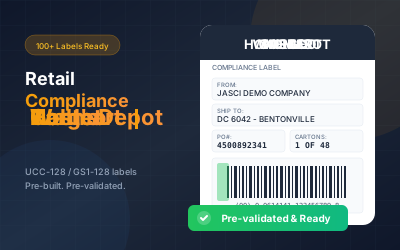
UCC-128 & GS1-128 Retail Compliance Labels: Complete Guide
Everything you need to know about compliance labels for Walmart, Target, Costco, Home Depot & 100+ retailers. Avoid costly chargebacks.
The Risk-Free WMS Migration Playbook
Complete 5-phase guide to migrating from legacy on-prem WMS to modern cloud—without shutting down operations.
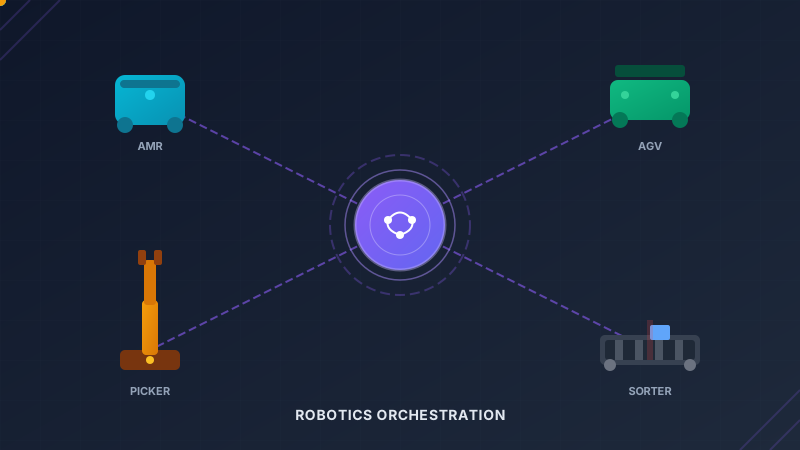
Robotics Orchestration: A Practical Guide
Learn how to integrate multiple robotic systems—AMRs, AGVs, and goods-to-person solutions—under a single orchestration layer.