UCC-128 & GS1-128 Retail Compliance Labels: The Complete Guide to Avoiding Chargebacks
Everything you need to know about retail compliance labels for Walmart, Target, Costco, Home Depot, and 100+ major retailers. Learn why building custom labels costs $50,000+ and how to achieve zero chargebacks from day one.
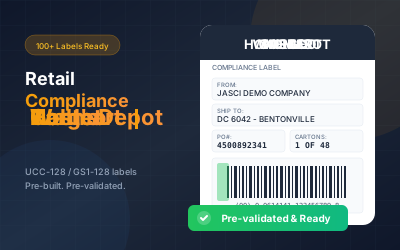
If you're shipping to major retailers like Walmart, Target, Costco, or Home Depot, you've probably encountered the frustrating world of compliance labels—and the expensive chargebacks that come when you get them wrong.
The problem? Compliance label specifications are nearly impossible to find online. Retailers guard their exact label requirements, leaving suppliers scrambling to build custom formats through trial and error. Each mistake costs thousands in chargebacks.
This comprehensive guide covers everything you need to know about retail compliance labels, including what they are, why they matter, and how to implement them without losing money or your sanity.
The Compliance Label Problem by the Numbers
Table of Contents
- What Are Retail Compliance Labels?
- UCC-128 vs GS1-128: Understanding the Standards
- The True Cost of Non-Compliance
- Major Retailers and Their Requirements
- Essential Label Components
- Common Compliance Mistakes
- Building vs. Buying Compliance Labels
- How to Implement Compliance Labels
- Staying Current with Changing Requirements
What Are Retail Compliance Labels?
Retail compliance labels (also called UCC-128 or GS1-128 labels) are standardized shipping labels required by major retailers for all inbound shipments. These labels contain critical data in both human-readable and barcode formats, allowing retailers to automatically receive, sort, and track your products through their supply chain.
Think of compliance labels as the "passport" your shipment needs to enter a retailer's distribution center. Without the correct format, your shipment gets rejected at the door—literally.
Why Do Retailers Require Them?
Major retailers process thousands of shipments daily across hundreds of distribution centers. Manual data entry is slow, expensive, and error-prone. Compliance labels enable:
Scanners instantly capture shipment data
Products flow to the correct locations
Shipments route directly to stores
Reduces manual data entry mistakes
Critical Warning
When your labels don't match their exact specifications—wrong barcode symbology, missing data fields, incorrect dimensions—their systems can't process your shipment. You get charged, and your supplier scorecard takes a hit.
UCC-128 vs GS1-128: Understanding the Standards
You'll see both "UCC-128" and "GS1-128" used interchangeably. Here's what you need to know:
The Evolution of Standards
UCC-128 (Uniform Code Council) was the original standard created in the 1980s. In 2005, UCC merged with international standards organizations to form GS1, and the standard was renamed GS1-128. They're the same thing—GS1-128 is simply the modern name.
Note: Many retailers and suppliers still use "UCC-128" terminology, especially in North America. Don't be confused; they refer to the same barcode standard.
What Makes GS1-128 Special?
GS1-128 uses Code 128 barcode symbology with special Application Identifiers (AIs) that define what each data element means:
| AI Code | Description |
|---|---|
| AI (00) | Serial Shipping Container Code (SSCC-18) |
| AI (01) | Global Trade Item Number (GTIN) |
| AI (10) | Batch/Lot Number |
| AI (15) | Best Before Date |
| AI (37) | Count of Trade Items |
| AI (400-403) | Customer Purchase Order Number |
| AI (410) | Ship To Location |
These Application Identifiers let scanners automatically parse complex data without human intervention. A single barcode can encode shipping destination, PO number, carton count, dates, and tracking numbers—all in a format every system can understand.
The True Cost of Non-Compliance
The retail compliance label problem isn't just technical—it's financial. Here's what non-compliance actually costs suppliers:
Direct Chargeback Costs
Most major retailers charge $2-$5 per carton for label non-compliance. This might not sound catastrophic until you do the math:
Industry-wide, retailers assess over $2.5 billion in annual chargebacks. Label non-compliance ranks in the top 3 causes, alongside short shipments and delivery failures.
Hidden Costs
Beyond direct penalties, label problems create cascading costs:
- Delayed payments: Some retailers withhold payment until compliance issues resolve (30-90 days)
- Lower supplier scorecards: Poor compliance ratings can reduce order volume or disqualify you from programs
- Rejected shipments: Worst case, your entire truckload gets refused and sent back
- Customer service time: Hours spent disputing chargebacks, providing documentation
Real-World Success Story
A mid-sized apparel supplier shipping to Walmart, Target, and Kohl's was experiencing 3.2% chargeback rate on label compliance. With $12M in annual retail revenue:
- • $384,000 in direct chargebacks annually
- • 15 hours/week disputing penalties
- • Lost 2 large accounts due to poor ratings
- • 0% chargeback rate on label issues
- • $384,000 annual savings
- • Vendor scorecard: 72% → 98%
Major Retailers and Their Requirements
Each major retailer has unique compliance label requirements. Here's what makes finding this information so difficult:
Why Specifications Are Hidden
Retailers don't publish their exact label formats publicly for several reasons: vendor agreements under NDA, frequent requirement changes, competitive advantage, and security concerns. This creates a massive problem: You can't comply with requirements you can't find.
Retailer-Specific Requirements
Walmart Compliance Labels
Chargeback rate: $2-$3 per cartonFormat:
4" x 6" thermal label, GS1-128 with SSCC-18 barcode
Required Fields:
- • PO Number (AI 400)
- • Ship To Location (AI 410)
- • Vendor Number, Carton count
- • SSCC barcode (AI 00)
Target Compliance Labels
Chargeback rate: $5 per carton (one of the highest!)Format:
4" x 6" thermal label with specific layout, GS1-128
Required Fields:
- • SSCC-18 barcode
- • PO Number with AI encoding
- • Department/Class, Ship-to DC
- • Vendor number, Carton count
Costco Wholesale Labels
Strict receiving windows applyFormat:
4" x 6" with distinct visual layout, GS1-128
Required Fields:
- • Warehouse destination
- • Item number, PO
- • Case quantity
- • SSCC-18, Vendor info
Home Depot Labels
Requires ASN that matches label data exactlyFormat:
4" x 6", GS1-128
Required Fields:
- • PO number (AI 400), SKU info
- • Ship-to RDC location
- • Carton sequence
- • Product description
The list continues with unique requirements for Lowe's, Kohl's, Macy's, Nordstrom, JCPenney, Amazon Vendor Central, Kroger, CVS/Walgreens, and dozens more.
The challenge: Each retailer needs different data fields, in different positions, with different barcode configurations. One label format absolutely cannot work for all retailers.
Essential Label Components
Understanding what goes into a compliant label helps you appreciate why they're complex to build:
SSCC-18 Barcode (Serial Shipping Container Code)
The SSCC-18 is the heart of every compliance label. This unique 18-digit number identifies your specific carton:
The SSCC must be unique for every carton, never reused, encoded in Code 128 with AI (00), and printed clearly at required size.
Layout and Dimensions
Standard Requirements
- • Label size: 4" x 6"
- • Thermal printing: Direct or transfer
- • Resolution: 203 DPI min, 300 DPI preferred
Barcode Specs
- • Barcode height: Minimum 1" tall
- • Quiet zones: 0.25" white space
- • Font sizes: 8-12pt human-readable
Barcode Quality (ANSI Grading)
Common Compliance Mistakes
Even with specifications, suppliers make predictable errors:
1. Wrong Barcode Symbology
Using Code 39 or Code 93 instead of Code 128. Fix: Always use Code 128 for GS1-128.
2. Missing or Incorrect Application Identifiers
Including AI parentheses in barcode data. Wrong: "(400)5432109876" Right: "4005432109876"
3. Invalid SSCC Check Digit
Incorrect mod-10 calculation. Fix: Use established libraries for check digit calculation.
4. Date Format Mistakes
Using MM/DD/YYYY instead of YYMMDD. Wrong: 12/25/2024 Right: 241225
5. Duplicate SSCC Numbers
Reusing SSCC numbers across shipments. Fix: Implement robust uniqueness validation.
Building vs. Buying Compliance Labels
Suppliers face a critical decision: build custom labels or use pre-built formats.
| Factor | Build Custom | Pre-Built Library |
|---|---|---|
| Time to First Retailer | 6-8 weeks | Minutes |
| Development Cost (10 retailers) | $48,000+ | $0 (included) |
| Testing & Chargebacks During Dev | $10,000-$50,000 | $0 |
| Ongoing Maintenance | You monitor & update | Automatic updates |
| Technical Resources | ZPL/EPL programming required | Self-service config |
| Total Cost (Year 1) | $50,000+ | Included with WMS |
The math is compelling. Even if you only ship to 3 retailers, pre-built labels pay for themselves in eliminated chargebacks within 2-3 months.
How to Implement Compliance Labels
Audit Current State
Document which retailers you ship to, current label formats, historical chargeback data, and printer infrastructure.
Choose Your Approach
Pre-built library (recommended) vs. custom development. Verify retailer coverage before deciding.
Configure Label Rules
Set up automatic label selection by customer, ship-to location, or order type.
Map Data Fields
Connect your system data (PO number, vendor ID, ship-to) to label requirements.
Test Thoroughly
Print test labels, verify scans, use ANSI grading, send samples to retailers before full rollout.
Train Your Team
Ensure warehouse staff understands when labels print and how to troubleshoot issues.
Staying Current with Changing Requirements
Retailer label requirements don't stay static. Changes happen 2-4 times per year on average due to technology upgrades, supply chain optimization, regulatory compliance, or mergers.
If Building Custom Labels:
- • Join industry groups (VICS, GS1 US)
- • Subscribe to retailer vendor portals
- • Monitor chargeback notices
- • Network with other suppliers
- • Response time: Weeks to months
If Using Pre-Built Library:
- • Provider monitors requirements automatically
- • Labels update in background
- • Ship with current format without action
- • No portal monitoring needed
- • Response time: Hours
Ready to Eliminate Chargebacks?
JASCI WMS includes the industry's most comprehensive compliance label library with 100+ pre-built retailer formats including Walmart, Target, Costco, Home Depot, and every major chain.
Stop searching. Stop guessing. Ship confidently with JASCI's compliance label library.