Key Takeaways
- 3PLs lose 5–15% of revenue annually to missed billing, manual errors, and siloed operations that legacy WMS platforms can’t solve.
- AI-powered onboarding cuts client setup from months to days, directly accelerating time-to-revenue and reducing professional services costs by 60%+.
- Robotics orchestration is no longer optional—vendor-agnostic integration with AMRs, AS/RS, and conveyors lets 3PLs scale throughput without scaling headcount.
- A unified platform beats best-of-breed: when WMS, billing, labor, shipping, and robotics share one data model, every decision is faster and every invoice is defensible.
Why Your WMS Checklist Matters More Than Ever
The third-party logistics industry is in the middle of a structural shakeout. E-commerce volumes continue to grow. Clients expect Amazon-speed fulfillment from day one. Margins are thin and getting thinner. And the technology decisions you make today will determine whether your 3PL scales profitably—or collapses under the weight of its own complexity.
Yet most 3PLs still evaluate warehouse management systems the way they did a decade ago: feature lists, module counts, and vendor demos that look great but say nothing about how the platform actually performs when you onboard your twentieth client or integrate your third robot vendor.
This guide takes a different approach. We’ve distilled the 10 WMS software requirements that consistently separate high-growth 3PLs from those that plateau. These aren’t nice-to-haves. They’re the capabilities that determine whether your technology is a growth engine or a growth ceiling.
The 3PL Growth Gap
Most 3PL warehouse management systems were built 10, 20, or even 30 years ago—long before omni-channel commerce, autonomous robots, or real-time visibility became the norm. The result is a widening gap between what clients demand and what legacy systems can deliver.
Siloed Operations
Legacy platforms force B2C and B2B into separate systems with duplicate item masters, separate inventory pools, and disconnected workflows.
Revenue Leakage
Without automated billing tied to execution, 3PLs lose 5–15% of revenue to missed charges, underpriced services, and manual invoice errors.
Slow Onboarding
Bringing a new client online can take weeks or months of manual data mapping, custom integrations, and workflow configuration.
Poor Visibility
When data lives in spreadsheets and disconnected tools, real-time insights into labor productivity and SLA performance are impossible.
The 10 Requirements
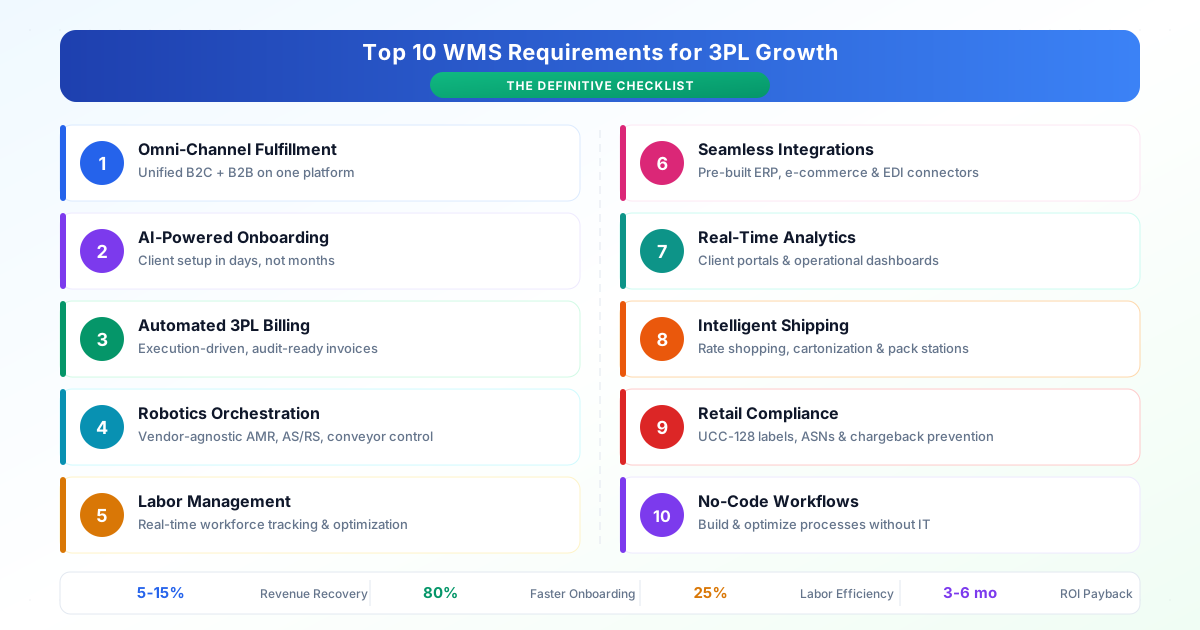
Below is the full checklist. Each requirement reflects a capability that directly impacts revenue, client retention, or operational scalability. If your current WMS can’t check all ten boxes, it’s time to evaluate what’s available.
Unified Omni-Channel Fulfillment
A modern 3PL WMS must handle B2C each-pick e-commerce orders and B2B case/pallet distribution on a single platform. Running separate systems for different order types creates duplicate item masters, fragmented inventory, and a training nightmare for warehouse associates.
The best platforms unify all order types under one roof: single-item DTC shipments, multi-line wholesale orders, marketplace fulfillment, and retail replenishment. One inventory pool. One set of workflows. One source of truth.
Why it matters: Clients increasingly need both B2C and B2B fulfillment. If your WMS forces them into separate silos, you lose the deal to a competitor who doesn’t.
AI-Powered Client Onboarding
Traditional WMS implementations take 6–12 months and cost $150K–$350K in professional services alone. For a 3PL that needs to onboard new clients quickly to generate revenue, that timeline is a dealbreaker.
AI-driven configuration changes the equation. Instead of consultants translating warehouse intent into static rules over months, AI validates configuration against execution readiness in real time. Automated data mapping, pre-built templates for retail, DTC, wholesale, and marketplace clients, and guided setup flows compress onboarding from months to days.
Automated 3PL Billing Tied to Execution
Revenue leakage is one of the most preventable profit killers in the 3PL business. The root cause isn’t a missing rate card—it’s the inability to reliably connect contract terms to what physically happened in the building.
A modern WMS should treat billing as a direct outcome of execution, not a separate accounting process. Every completed warehouse action—receiving a carton, putting away a pallet, picking a unit, shipping a package—should automatically generate a billable event with a full audit trail. Storage fees, pick charges, returns processing, kitting, relabeling: all captured and invoiced without manual reconstruction.
The most advanced platforms support up to five pricing tiers per transaction type with AI-calculated volume breaks, tiered rates, and accessorial triggers. The result: invoices generated continuously as work happens, not reconstructed at month-end from spreadsheets and memory.
Bottom line: 3PLs that automate billing tied to execution recover 5–15% in previously lost revenue and cut dispute resolution time from hours to minutes.
Native Robotics Orchestration
Automation is no longer reserved for enterprise 3PLs with massive budgets. AMRs, goods-to-person shuttles, AS/RS systems, and conveyor sortation are all becoming accessible—but only if your WMS can actually orchestrate them.
Robotics orchestration means a single intelligent layer that assigns tasks to robots and humans interchangeably based on priorities, proximity, and availability. It means vendor-agnostic integration so you’re never locked into a single robotics provider. And it means pre-configured workflow templates that eliminate the “science project” risk of custom automation deployments.
Labor Management & Workforce Optimization
Labor accounts for the majority of warehouse operating costs. A WMS that can’t measure, track, and optimize labor in real time is leaving the biggest expense category unmanaged.
Your WMS should provide real-time productivity tracking by worker, client, and task type. Engineered labor standards let you benchmark performance objectively. Forecasting tools align staffing levels with demand, preventing both overtime blowouts and idle capacity. And manager dashboards give floor supervisors the visibility they need to coach in real time—not after the shift ends.
The best systems go further with gamification elements that drive engagement and performance improvement organically, turning productivity data into a motivational tool rather than just a reporting metric.
Seamless Integration Framework
Modern 3PLs connect with dozens of external systems. Every new client brings their own ERP, e-commerce platform, marketplace feeds, and carrier preferences. If each integration is a custom development project, your onboarding timelines and IT costs spiral out of control.
A growth-ready WMS includes pre-built connectors for the platforms that matter: Shopify, Amazon, Walmart, BigCommerce on the commerce side. NetSuite, SAP, Oracle, and Microsoft Dynamics on the ERP side. UPS, FedEx, USPS, and DHL for carriers. EDI, API, and webhook connections for everything else.
The goal isn’t just connectivity—it’s speed. The right integration framework reduces the technical overhead of each new client so your team can focus on operations, not plumbing.
Real-Time Analytics & Client Portals
Your clients expect transparency. They want to see real-time order tracking, inventory levels, SLA performance scorecards, and cost-to-serve analysis without calling your operations team. A WMS that doesn’t offer self-service client portals puts your account managers in the middle of every question.
Beyond client-facing visibility, your internal analytics need to deliver real-time operational dashboards covering throughput, labor utilization, error rates, and capacity planning. Historical trends and predictive insights let you spot problems before they become SLA violations.
Pro tip: Client portals aren’t just an operational tool—they’re a retention tool. 3PLs that give clients dashboard access report significantly higher contract renewal rates.
Intelligent Shipping & Pack Station Technology
Parcel shipping can represent 10–50% of total supply chain costs. A WMS that treats shipping as an afterthought is leaving massive savings on the table.
Your platform should include real-time carrier rate shopping across all major carriers, AI cartonization logic that matches orders to optimal box and bag sizes (stop shipping air), and pack stations optimized for singles, multi-line, and batched orders with instant label printing. For 3PLs specifically, the ability to up-charge shipments—leveraging your negotiated carrier rates while providing clients better pricing than they could get independently—turns shipping from a cost center into a profit center.
Retail Compliance & Chargeback Prevention
B2B retail clients—think Walmart, Target, Costco, Home Depot—have strict labeling, documentation, and delivery requirements. Non-compliance leads to chargebacks that erode margins and damage retailer relationships. For 3PLs handling retail distribution, compliance automation isn’t optional.
Your WMS must automate retailer-specific pallet and carton labels (UCC-128/GS1-128), Advanced Ship Notices (ASNs), Bills of Lading (BOLs), and routing guide compliance. The system should flag exceptions before they ship, not after the chargeback arrives. With the right platform, compliance becomes a process, not a scramble.
No-Code Workflow Builder & Continuous Optimization
Every 3PL client brings unique requirements: specific receiving processes, custom QC workflows, particular packing rules, or specialized shipping logic. If every client-specific adjustment requires a developer or a professional services engagement, you’re paying a “change tax” that compounds with every new client.
A no-code workflow builder lets your operations team design and modify fulfillment processes in hours, not weeks. Configure receiving, picking, packing, QC, and shipping logic without waiting on IT. Adapt to client-specific requirements on the fly. And most importantly, keep optimizing after go-live—because a warehouse that stops improving is a warehouse that starts losing.
The real cost of WMS ownership isn’t the license—it’s the cost of change. Platforms that make optimization part of daily operations, rather than a paid consulting project, deliver dramatically lower total cost of ownership over time.
How These Requirements Work Together
Individually, each of these capabilities matters. Together, they compound. When your WMS, billing, labor management, shipping optimization, and robotics orchestration all share a single data model and execution engine, the results are transformative:
This is the fundamental advantage of a unified platform over a patchwork of best-of-breed solutions. When everything runs on one engine, every improvement compounds across your entire operation.
The ROI of Getting This Right
Technology should do more than automate tasks—it should improve your bottom line. When a 3PL invests in a WMS that meets all ten requirements, the financial impact compounds quickly:
How to Evaluate Your Next WMS
Vendor demos can be deceiving. Every WMS looks capable when the presenter controls the script. When you’re evaluating platforms against these ten requirements, focus on proof over promises:
- 1Ask to see a live onboarding of a new client — not a pre-configured demo environment.
- 2Request an actual invoice generated from warehouse execution data with an audit trail you can drill into.
- 3Ask which robotics vendors are actively integrated in production, not "supported on the roadmap."
- 4Test the workflow builder yourself. Can your ops team modify a process without engineering help?
- 5Ask about post go-live changes. What does it cost and how long does it take to add a new pick method or billing rule?
The 3PLs that invest in modern, unified warehouse technology today will be the market leaders tomorrow. In a low-margin industry where efficiency compounds, the gap between those running modern platforms and those clinging to legacy systems will only widen.
Frequently Asked Questions
What is a WMS for 3PL, and how is it different from a standard WMS?
A 3PL WMS is designed for multi-client warehouse operations. Unlike a standard WMS that serves a single company, a 3PL WMS must support client-specific workflows, billing rules, SLA tracking, inventory segregation, and reporting—all within the same platform. It also needs fast client onboarding capabilities that a single-tenant WMS doesn't require.
How does AI-powered onboarding actually reduce implementation time?
AI-driven configuration replaces the traditional consultant-led blueprint process. Instead of humans manually translating warehouse requirements into system rules over weeks, AI validates configuration against execution readiness in real time. Automated data mapping, pre-built templates, and guided setup flows compress what used to take months into days or weeks.
What is robotics orchestration and why does my 3PL need it?
Robotics orchestration is an intelligent coordination layer that manages autonomous robots, conveyor systems, and human workers through a single platform. It assigns tasks based on priorities, proximity, and availability. For 3PLs, it means scaling throughput without proportionally scaling labor costs—and doing so with vendor-agnostic flexibility rather than lock-in.
How much revenue do 3PLs typically lose to billing leakage?
Industry data shows 3PLs lose 5–15% of revenue to missed charges, underpriced services, and manual invoice errors. The primary cause is billing systems that are disconnected from warehouse execution. When billing is a direct outcome of confirmed work events, leakage drops dramatically.
Can a modern WMS integrate with my existing ERP and e-commerce systems?
Yes. Modern WMS platforms include pre-built connectors for major ERPs (NetSuite, SAP, Oracle, Dynamics 365), e-commerce platforms (Shopify, Amazon, Walmart, BigCommerce), carriers, and EDI providers. The key differentiator is how fast a new integration can go live—the best platforms reduce this to days, not weeks.
What is the typical ROI timeline for a modern 3PL WMS?
Most 3PLs see measurable ROI within 3–6 months through recovered billing revenue, reduced labor waste, faster client onboarding, and shipping optimization. The exact timeline depends on your current operations, but the combination of revenue recovery and cost reduction typically delivers payback well within the first year.
Ready to Check All 10 Boxes?
JASCI’s unified platform delivers every capability on this list—from AI-powered onboarding and automated billing to native robotics orchestration and no-code workflows. See it in action.