From System of Record to Active Operating Layer
JASCI Software has announced Phoenix, its AI-native flagship for 3PL, omnichannel retail, wholesale, and highly automated distribution. The announcement marks a shift from warehouse software that waits for users to interpret transactions toward a platform that can continuously evaluate conditions, coordinate decisions across functions, and help execute the next best action.
Traditional WMS platforms were designed primarily to capture inventory movements and guide fixed workflows. When demand changes, labor tightens, a carrier cutoff approaches, or an automation zone becomes congested, supervisors often have to assemble the full picture across several screens before they can respond. Phoenix brings intelligence into the operational core so the WMS can help identify the issue while the work is still in motion.
“The next generation understands the operation, reasons about what should happen, collaborates across functions, and takes action. That is Phoenix.”
Read Craig Wilensky's full quote
“The WMS category was built for a different era,” said Craig Wilensky, CEO of JASCI Software. “Better screens and better reports are not the next generation. The next generation understands the operation, reasons about what should happen, collaborates across functions, and takes action. That is Phoenix.”
This approach builds on JASCI's broader cloud platform for warehouse management, warehouse execution, robotics orchestration, parcel shipping, labor, analytics, and 3PL billing. The practical difference is that AI is connected to the same data, controls, and workflows the operation already uses.
What Is Phoenix?
Phoenix is a warehouse management system designed around a network of domain-specific AI agents. Receiving, quality control, slotting, replenishment, cycle counting, putwalls, waves, allocation, packaging, labels, shipping rules, final-mile routing, and 3PL billing can each have a specialist that understands the process and can hand work to another agent when a decision crosses a functional boundary. For example, an inbound agent that detects an unexpected inventory surge can alert slotting, replenishment, labor, and automation agents at the same time. Each specialist can reassess its part of the operation, helping the warehouse respond as a coordinated system instead of a collection of disconnected modules.
The Phoenix system does not simply add a chatbot to a traditional WMS. AI is the operating layer: it reasons about the warehouse, collaborates across functions, and acts. Traditional warehouse software records transactions and waits for people to click. Phoenix continuously evaluates orders, inventory, labor, automation, shipping, and service commitments, then coordinates what should happen next.
Phoenix is new, but the operating foundation is not. JASCI has modernized and refactored more than 3.5 million lines of software to create the platform, and its established technology processes more than 4 billion transactions annually.
How Does Phoenix Work?
Phoenix follows a continuous operating loop:
- Observe: Read live signals from orders, inventory, labor, automation, shipping, and service commitments.
- Ground: Combine the request with operational state, WMS knowledge, tenant-authored information, permissions, and policy.
- Reason: Route the work to the right specialist agents and coordinate decisions that cross warehouse functions.
- Act: Recommend or execute the approved workflow, pausing when a human decision or higher permission is required.
- Improve: Use results, exceptions, and performance data to inform the next recommendation or configuration change.
Because this loop lives inside the WMS, intelligence stays connected to the work instead of being isolated in a separate chatbot or reporting tool.
AI Studio: A Team of Warehouse Specialists
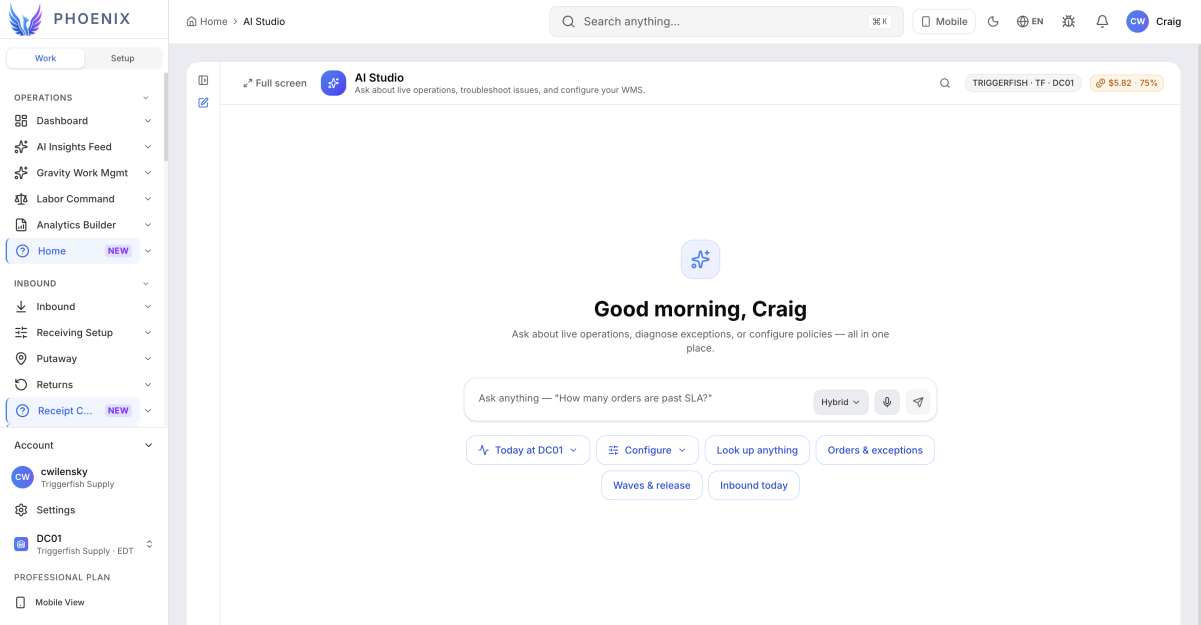
AI Studio is the workspace where operators and managers interact with Phoenix's specialist agents. A user can investigate an exception, ask about live operations, draft a policy, build a report, or coordinate a response across receiving, inventory, fulfillment, shipping, labor, automation, and billing from one conversational surface.
The important distinction is specialization. Instead of asking one generic assistant to understand every warehouse process equally well, Phoenix routes the request to agents with domain context and allows them to collaborate when the answer spans several functions. That can reduce the manual handoffs that slow down exception resolution and configuration work.
From Intent to Approved Action
Phoenix places an always-on AI sidebar on operational pages, so supervisors can ask for help from the screen they are already using. They can look up an order, explain an exception, draft a policy, or rebalance labor without leaving the active grid or restating which record is under review.
AI Remote Control goes beyond answering questions. Every control on every screen is addressable, enabling Phoenix to fill forms, select actions, and drive workflows headlessly. An operator describes the desired outcome; Phoenix can handle the navigation and repetitive screen work, explain its reasoning, and wait wherever policy requires human approval.
This model keeps people in charge of business intent. Role-based permissions, tenant isolation, write gates, audit records, and approval requirements continue to determine what each user and agent can see or change.
The Native AI Stack Behind Phoenix
Phoenix's user experience is supported by an AI stack built into the operational core:
- AI database: Oracle 26ai provides in-database vectors, embeddings, and HNSW indexing so inference can operate close to live warehouse data.
- AI models: Claude Sonnet and Haiku support reasoning, while ONNX predictive models address order risk, anomalies, and demand in the operational path.
- Grounded retrieval: Retrieval-augmented generation uses the WMS domain corpus, current operational state, and tenant-authored knowledge, with citations and source analysis.
- Conversational experience: A global AI dock supports specialist routing, voice, multilingual labels, and continuity inside the active workflow.
- AI onboarding and configuration: Guided setup combines progress tracking and data accelerators with a recommend, draft, simulate, review, and promote process.
- AI analytics: Natural-language questions can become governed queries, reports, visualizations, and reusable drill-downs without a separate BI ticket.
- Open, governed access: An MCP interface lets approved external assistants use JASCI capabilities while inheriting tenant scope, permissions, write gates, audit, retrieval telemetry, and model monitoring.
Continuous Delivery Without Stopping the Warehouse
Phoenix is designed for zero-downtime deployments using additive database changes, feature flags, silent validation, and non-disruptive updates. Old and new versions can run together during a rollout, allowing warehouses to operate around the clock without planned maintenance windows or requests for users to log off.
JASCI Software's AI-native platform and engineering approach enable product development approximately 50 times faster than a traditional WMS cycle of specifications, custom code, and annual releases. That figure describes JASCI's development cadence rather than a guaranteed customer savings rate, but faster delivery can shorten the wait for new operational capabilities.
“When you develop 50 times faster, the roadmap is not a promise. It is a cadence.”
Read Dr. Dan Napoli's full quote
“Cloud was step one. Providing Flexibility was step two. Native AI is the leap that lets an operations team change the warehouse as fast as the market changes, and lets us build the next capability at the same pace,” said Dr. Dan Napoli, CTO of JASCI. “When you develop 50 times faster, the roadmap is not a promise. It is a cadence.”
What Are the Benefits for Customers?
- Faster operational response: Phoenix can connect signals across the warehouse and surface a coordinated next step before an exception becomes a larger bottleneck.
- Less screen and handoff friction: AI Studio and AI Remote Control reduce repeated navigation, data re-entry, and cross-team follow-up.
- More adaptable workflows: Natural-language configuration, simulation, and governed promotion help operations teams change rules without turning every improvement into a custom development project.
- Better use of labor and automation: Agents can consider staffing, zone conditions, work queues, and equipment together instead of optimizing each resource in isolation.
- More consistent decisions: Approved policies can be applied repeatedly while explanations, permissions, and audit records make outcomes easier to review.
- Continuous access to improvements: Zero-downtime delivery helps customers receive new capabilities without interrupting 24x7 warehouse operations.
The value is not fully autonomous decision-making without oversight. It is governed autonomy: people define the objectives and guardrails, while Phoenix analyzes more signals and completes more authorized work than an individual could manage manually.
See how JASCI connects AI to governed warehouse configuration and execution.Explore JASCI AI Technology →
Where Can Phoenix Be Used?
Phoenix applies the same agent-based model across a wide range of warehouse scenarios:
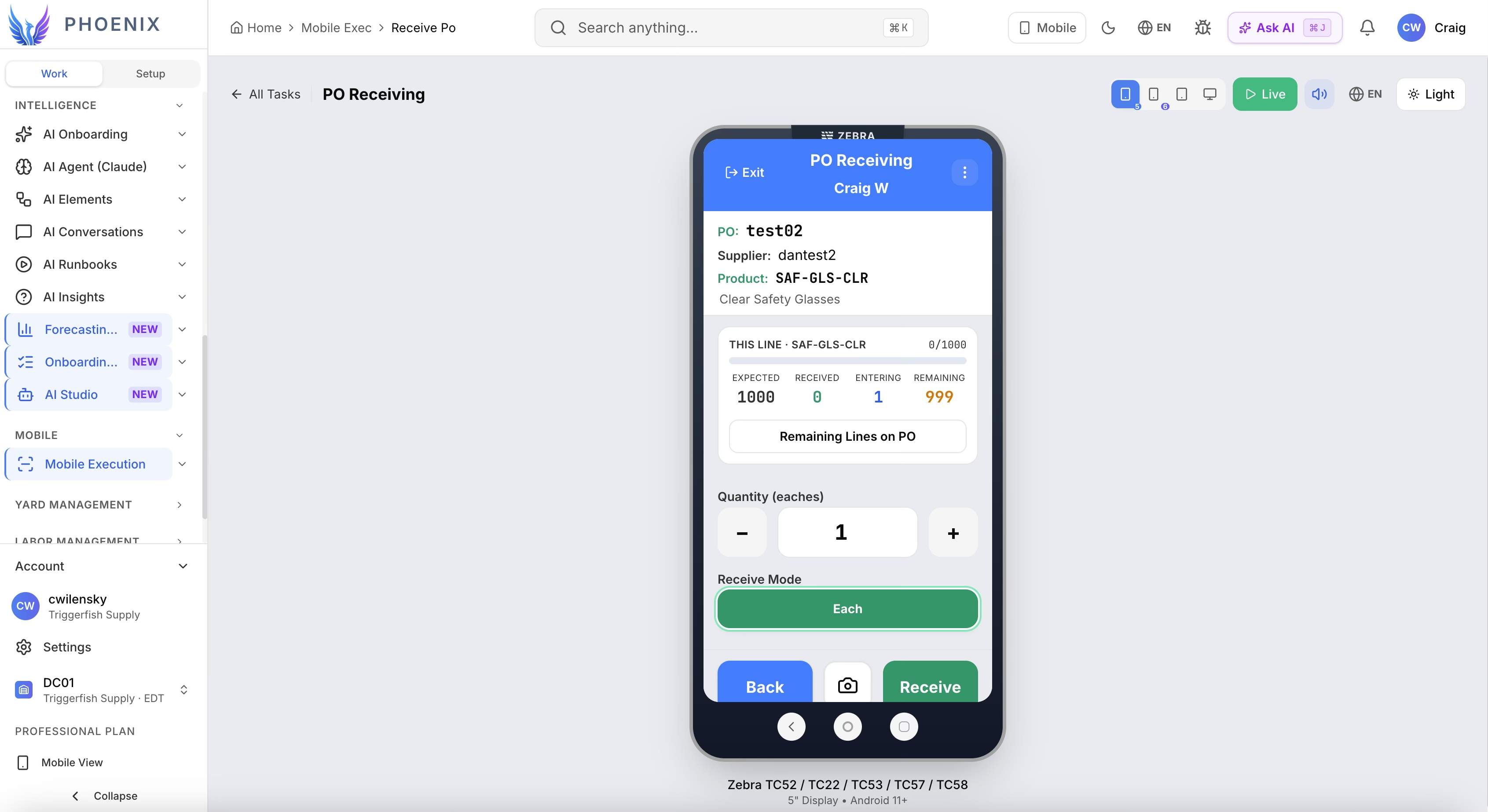
- Inbound and inventory coordination: Respond to unexpected receipts, direct putaway, adjust replenishment, and initiate cycle-count or quality workflows.
- Label Studio: Design, preview, duplicate, bind, proof, and publish warehouse labels without a separate vendor project. The launch material describes 85 carton and UCC-128 starters; JASCI's current compliance-label library lists more than 100 retailer formats.
- Shipping AI: Create carrier rules conversationally, compare rates across carriers, and preflight proposed policies against historical rate-shop activity before activation.
- Packaging and Pallet Build Studios: Configure cartonization, mixed-SKU cube, store-friendly tiers, heavy-to-light logic, and temperature-zone separators in plain language.
- Analytics Builder: Ask for late orders by carrier or another operational question and turn it into a governed, reusable report.
- Labor Command: View staffing by zone and receive suggestions to move people before a bottleneck grows.
- Dynamic Slotting: Use operating data and aisle-level heat maps to improve inventory placement as demand changes.
- Wave, allocation, and putwall agents: Draft, simulate, and save release policies, work classifications, cube assignments, and downstream routing decisions.
- Final-mile and 3PL billing agents: Coordinate own-fleet routing and build rate cards tied to the warehouse activity that generated each charge.
These use cases can support 3PL, ecommerce, retail, wholesale, consumer products, manufacturing, pharmaceutical, automotive, and highly automated facilities. The shared advantage is cross-functional context: an action in one part of the operation can inform the agents responsible for what happens next.
What Does Phoenix Mean for Customer ROI?
Phoenix creates value by shortening the distance between a signal, a decision, and an approved action. The measurable impact can appear in labor productivity, order cycle time, inventory accuracy, shipping cost, billing capture, implementation effort, downtime avoidance, and the cost of making post-go-live changes.
| Measure | Published JASCI benchmark | Primary operating lever |
|---|---|---|
| Labor cost reduction | 30-50% | Directed work and optimized workflows |
| Inventory accuracy | 99.8% | Real-time tracking and cycle counting |
| Faster fulfillment | 40% | Intelligent automation from order to ship |
| Shipping cost savings | 15-25% | Rate shopping and cartonization |
JASCI's AI technology materials also have more than 60% lower professional-services effort and $150,000 in modeled direct implementation savings for a mid-size implementation. These figures are vendor-published benchmarks, not guaranteed outcomes; actual ROI depends on baseline performance, order mix, carrier contracts, labor model, automation, integrations, and deployment scope.
A credible business case should use 60 to 90 days of representative operating data and compare baseline performance with post-deployment results across labor, freight, packaging, billing, downtime, and change-project costs.
Measure time to value as well as steady-state savings. A platform that reaches production faster and lets operations teams improve workflows after go-live can reduce both the initial implementation burden and the long-term cost of change.
Why Was The Previous Way So Difficult?
Legacy warehouse environments often separate the system of record from the people and tools responsible for interpreting and acting on it. A transaction is recorded, a report is generated, a supervisor finds the exception, and several teams move through separate modules to adjust inventory, labor, shipping, or automation.
| The Previous Way | The Phoenix Way |
|---|---|
| A generic chatbot sits beside the WMS | Specialist agents operate with warehouse context inside the platform |
| Supervisors leave the active screen to research an issue | The always-on sidebar retains the page and record context |
| People click through forms and workflows manually | AI Remote Control can execute authorized screen actions and pause at approval gates |
| Functions optimize their own queues separately | Agents coordinate decisions across inbound, inventory, labor, automation, shipping, and billing |
| Reports become BI tickets | Natural-language questions can become governed reports and drill-downs |
| Label, carrier, and packaging changes become vendor projects | Studios let authorized users draft, test, and promote configuration |
| Changes wait for release windows and regression projects | Feature flags, silent validation, and zero-downtime deployment support continuous delivery |
Traditional implementation adds another translation layer: consultants turn warehouse intent into documents, static rules, custom code, and testing plans before the operation can prove the workflow. JASCI's AI technology page places a typical legacy implementation at 6 to 12 months or more and lists mid-size implementation costs of $150,000 to $350,000, illustrating why faster configuration and safer post-go-live change matter to total cost of ownership.
Key Takeaways
- Phoenix is an AI-native WMS built around specialized agents, not a general chatbot attached to a legacy platform.
- AI Studio brings live operations, exception diagnosis, configuration, analytics, and cross-functional agents into one workspace.
- AI Remote Control can operate addressable screen controls and authorized workflows while respecting permissions and approval gates.
- The platform connects native AI, live warehouse data, grounded retrieval, predictive models, analytics, and open MCP access in one governed stack.
- Customer value can come from faster response, lower manual effort, safer configuration, continuous delivery, and measurable improvements across labor, inventory, fulfillment, shipping, and implementation.
- General availability is planned for October 2026.
Frequently Asked Questions
How is Phoenix different from a traditional WMS with a chatbot?
A chatbot usually answers questions beside an existing application. Phoenix uses AI as an operating layer: specialized agents work with live warehouse context, coordinate across functions, and can carry out approved actions inside the WMS.
What is AI Studio?
AI Studio is the workspace where users interact with specialized warehouse agents. It supports live operational questions, exception diagnosis, policy configuration, reporting, and cross-functional coordination from one conversational surface.
What is AI Remote Control?
AI Remote Control makes every screen control addressable by Phoenix. The assistant can fill forms, select actions, and drive authorized workflows while preserving permissions, explanations, auditability, and required human approvals.
Does Phoenix replace warehouse managers or supervisors?
No. Leaders continue to define objectives, policies, constraints, permissions, and approval gates. Phoenix analyzes signals and executes within those boundaries, while people retain oversight of decisions that require judgment or authorization.
How does Phoenix keep responses grounded?
Phoenix uses retrieval-augmented generation against the WMS domain corpus, live operational state, and tenant-authored knowledge. Citations and source analysis help users trace an answer to information available in the deployed environment.
Can customers connect other AI assistants?
Yes. Phoenix includes an MCP interface for approved external and in-house assistants. JASCI's published MCP materials describe approximately 290 operational tools available through a tenant-scoped, permission-aware, auditable endpoint.
Which warehouse operations does Phoenix support?
Phoenix spans receiving, inventory, quality control, slotting, replenishment, cycle counting, waves, allocation, putwalls, packaging, compliance labels, shipping, labor, analytics, robotics, final-mile routing, and 3PL billing.
Is Phoenix secure for enterprise operations?
JASCI states that Phoenix is SOC 2 Type II certified. The platform also includes tenant isolation, inherited permissions, write gates, configuration audit, retrieval telemetry, and model-drift monitoring. Review JASCI's cloud security and compliance architecture for additional platform context.
When will Phoenix be available?
JASCI plans general availability for October 2026. Prospective customers can contact JASCI now to discuss fit, implementation options, and the data and governance needed for deployment.
See What an AI-Native Warehouse Looks Like
Bring JASCI your highest-friction workflow, exception, or operating goal and see how Phoenix can connect the data, decision, approval, and action in one WMS.