Key Takeaway
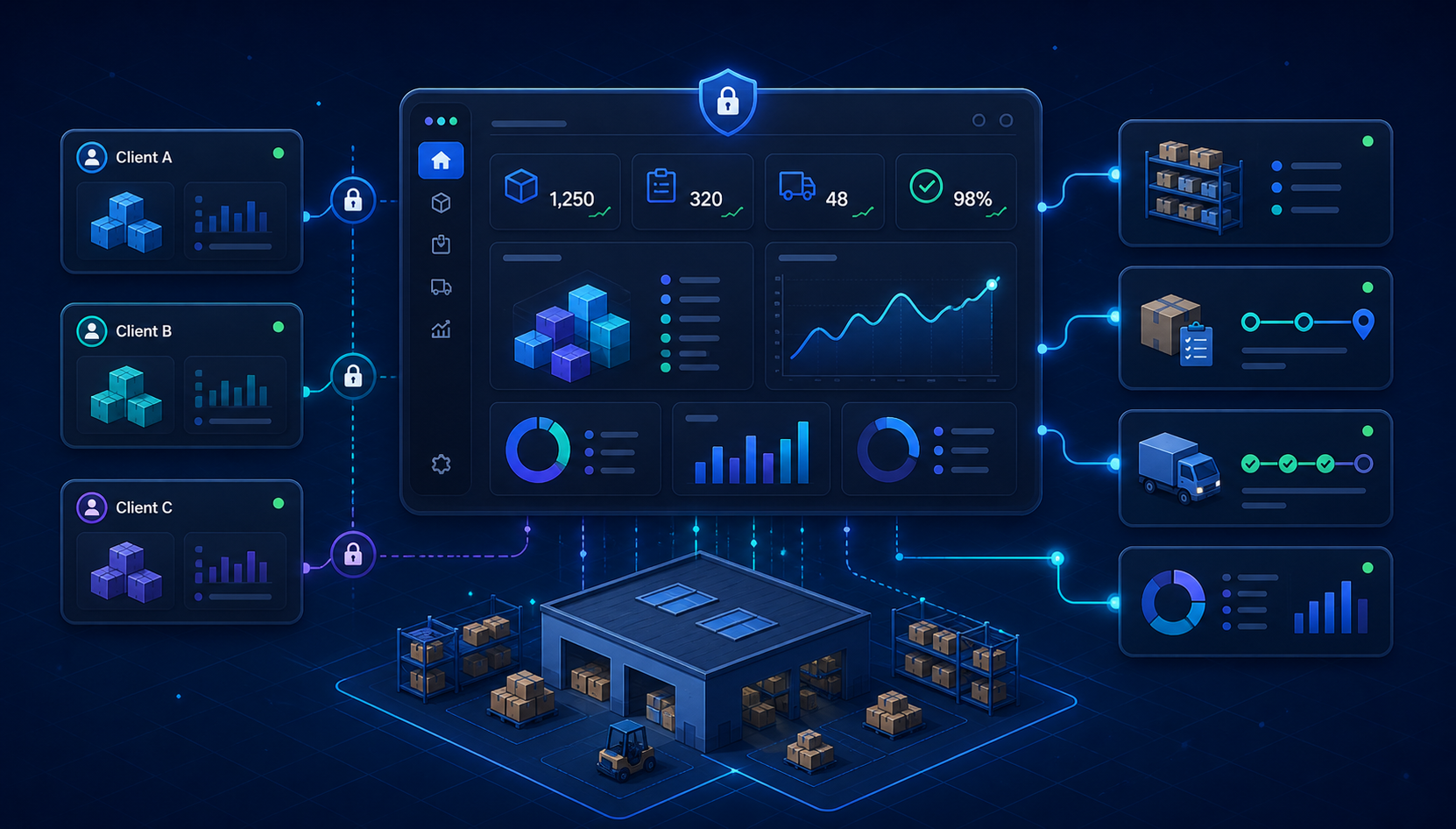
The next high-value warehouse AI use case may not be another optimization behind the scenes. It may be giving each 3PL customer a faster, safer way to understand what is happening with their inventory and orders.
1. The Visibility Gap in 3PL
When people talk about AI in the warehouse, the conversation usually stays on the floor: faster picking, smarter slotting, better labor planning, and fewer touches. Those gains matter. But they leave out a group with just as much to gain—the brands and shippers whose inventory a 3PL stores and whose orders it fulfills.
These customers live in the dark more than they'd like to admit. They email their account rep to ask “Did my shipment go out?” They wait for a Monday report to learn Friday's numbers. They find out about a problem only after it's become their problem too.
JASCI's Phoenix WMS changes that—by putting AI directly in the hands of your clients.
2. The Market Is Asking for More
Visibility is now part of the customer experience. The 2025 Third-Party Logistics Study (NTT DATA, Penske Logistics, and Penn State) found that 68% of shippers identified control-tower visibility as a top must-have. It also found that 69% of shippers and 68% of 3PLs viewed supply-chain visibility as an area in need of change.
3. From Lookup Portal to Answer Engine
JASCI's current 3PL warehouse management platform already supports client portals, real-time order tracking, inventory visibility, reporting, and analytics. Its multi-company architecture keeps each company's inventory, orders, workflows, documents, and integrations logically separated while still supporting shared physical operations.
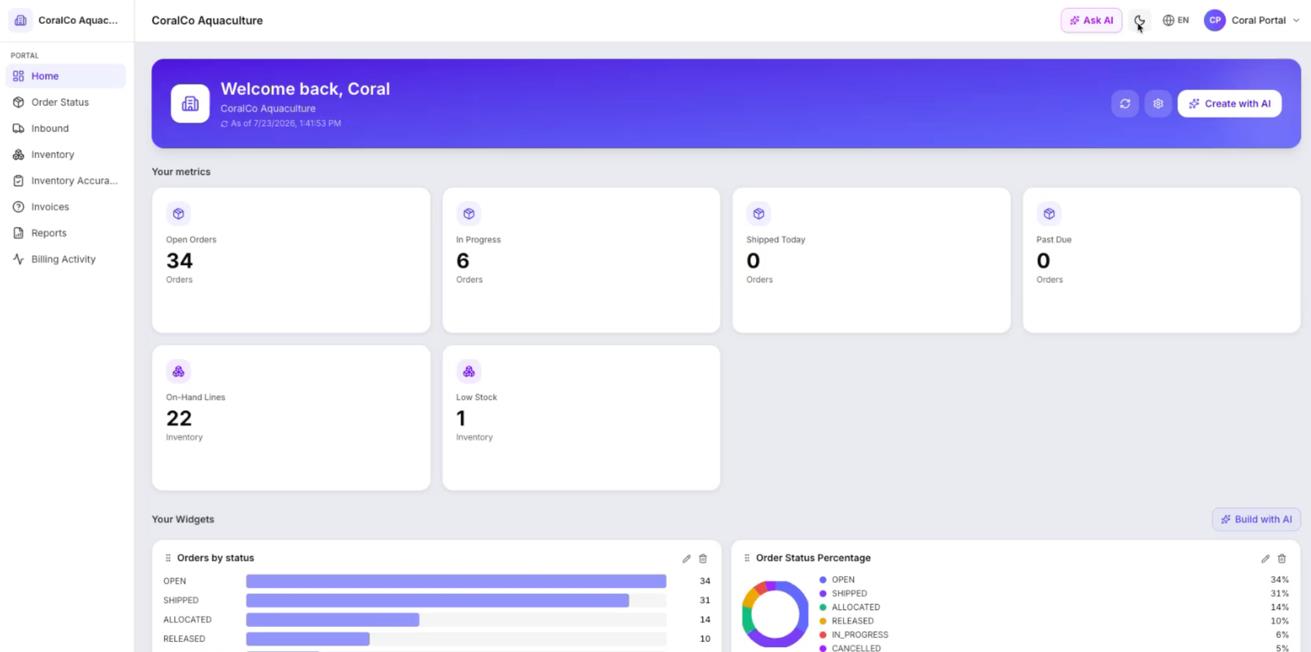
That governed data foundation is what makes a useful AI experience possible. When a conversational layer is connected to live, permission-scoped warehouse data, the portal can do more than display tables. It can interpret a client's question, retrieve the relevant records, summarize what matters, and show the evidence behind the response.
4. What Makes a 3PL Client Portal AI-Native?
Clients can just ask
Instead of hunting through menus or filing a ticket, a client can type a plain-English question—“Where are my orders from yesterday?” or “How much of SKU 4471 is on hand?”—and get an instant, accurate answer scoped only to their own data.
Answers are grounded, not guesses
The AI pulls from live warehouse data and JASCI's expert knowledge base, so what a client sees is real and current—not a stale nightly snapshot. A useful response distinguishes on-hand, allocated, available, held, and damaged inventory instead of returning one unexplained number.
Every answer shows its evidence
The portal identifies the data timestamp, filters, business definition, and supporting orders, shipments, inventory records, or transactions behind every response.
Self-service that reduces the “where is my order?” flood
The questions that used to clog your account managers' inboxes get answered instantly, around the clock, without a human in the loop. Because everything is company-scoped and permission-controlled, clients only ever see their own information.
5. Real-Time Visibility, Not Yesterday's Snapshot
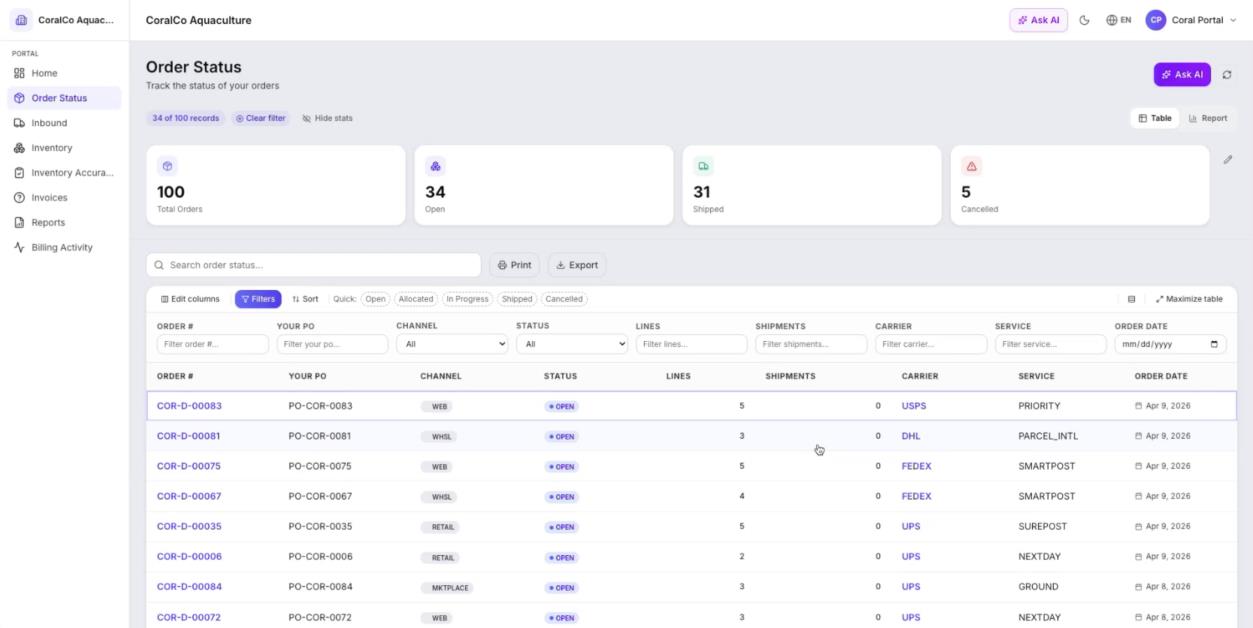
For a client, the difference between “data” and “current data” is everything. JASCI's intelligence runs on a live, always-fresh view of the operation:
Live inventory
On-hand, available, on-hold, and in-transit quantities as they change on the floor.
Live order status
From received to allocated to picked to shipped, with tracking as soon as a package leaves the dock.
No more “let me check”
The client sees the same truth your operations team does, at the same moment.
6. AI Insights, Alerts & Proactive Exception Management
This is where AI stops being reactive and starts being proactive. JASCI's always-on intelligence watches each client's operation in the background and speaks up before small issues become big ones.
Set-it-in-plain-English alerts
A client or their account team can say "let me know when trouble orders go over 5" or "alert me if orders on hold climb"—and the system watches for it automatically.
Alerts that reach people where they are
When a threshold is crossed, the platform can notify by in-app card, text message, or email—so nobody has to be staring at a dashboard to catch a problem.
Proactive exception management
Trouble orders are caught and explained—shortages, damages, mis-picks, lot or serial mismatches—with the AI pointing to the likely cause. The client stays informed automatically rather than being the last to know.
Every alert explains itself
Rather than a cryptic code, the AI describes what happened, why it matters, and what to do about it.
Why it matters: Exceptions are where client relationships are won or lost. Faster resolution means fewer downstream disappointments for their customers—which reflects well on both of you.
7. Questions Clients Should Be Able to Ask
An AI-native portal should handle the questions that today consume account-team time and delay client decisions:
“How much of SKU 4471 is available to promise across all locations?”
“Which orders received before noon have not shipped, and why?”
“What is most likely to miss today’s carrier cutoff?”
“How did fill rate and order cycle time change this week?”
“What operational events contributed to this month’s charges?”
Important: AI should never invent the explanation. When data is incomplete, ambiguous, or outside the user's permissions, the portal should state the limitation and route the question to a person.
8. Reporting, Analytics & AI-Built Dashboards
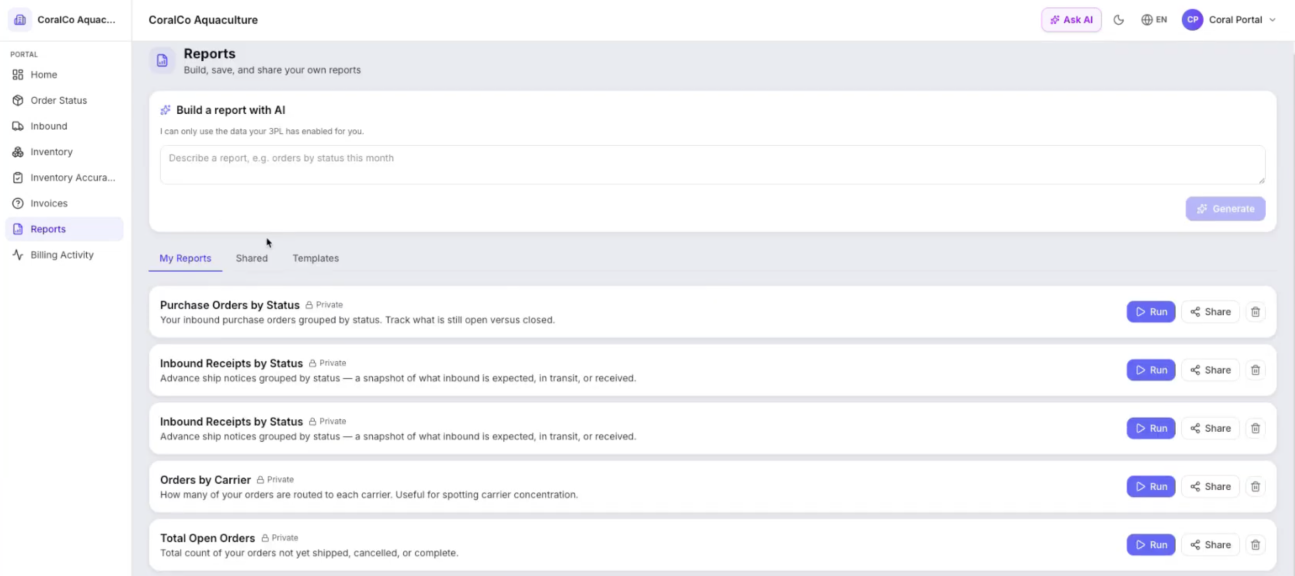
Every client wants to know how their fulfillment is really performing. JASCI turns a deep catalog of reports—hundreds of them—into a conversation any client can have, no analyst required.
Ask questions, get answers
- Clients can ask for the metrics that matter to them and get instant results, root-cause drill-downs, and side-by-side comparisons—in natural language
- Dashboards they can build by describing them—instead of learning a report builder, the AI creates the widget
- Executive summaries on demand: KPI snapshots that translate raw warehouse activity into the numbers leadership cares about
Self-service for clients
- Secure, branded portal with their own inventory, order, and performance data
- Permission-based access levels for different users and roles
- Self-service reporting that reduces status inquiry emails by 80%
- Export data instantly in CSV, Excel, PDF, or stream via API
9. Billing & Invoices, Fully Transparent
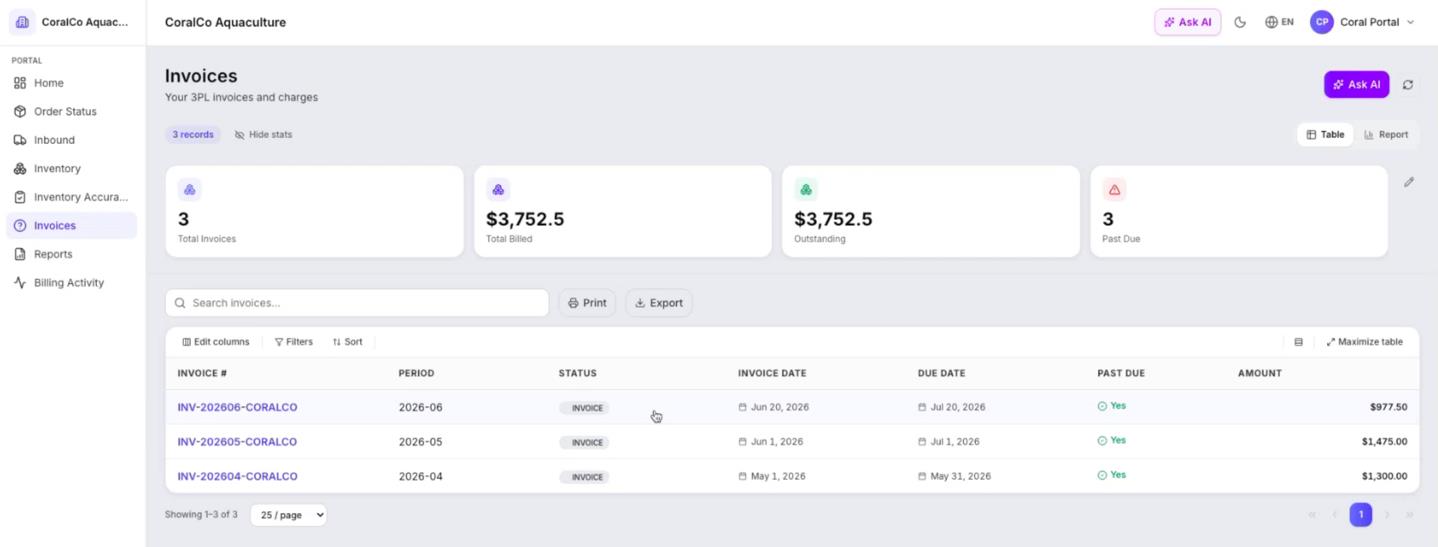
Nothing erodes a client relationship faster than a surprise invoice. JASCI's client portal gives every customer a clear, self-service view of exactly what they owe and why:
Outstanding balance at a glance
Current amount due, plus a running total for the billing period in progress.
Full invoice status
Open, past-due, and paid invoices in one place, with no waiting for a month-end statement.
Line-item transparency
Every charge tied to a real warehouse activity—receiving, putaway, pick/pack, shipping, storage, value-added services—and to the client’s agreed rate card and volume tiers.
Drill-down to the source
Trace any invoice line back to the exact transaction that created it. Just ask "What’s my balance?" or "Why did my costs rise this month?" and get an instant, plain-English answer.
The result is billing that builds trust instead of disputes—fewer reconciliation calls for your team, and complete confidence for your client.
10. AI-Powered Planning & Forecasting
AI doesn't just report the past—it helps clients get ahead of the future. JASCI's built-in prediction models give clients a forward-looking view:
Demand and volume signals
Help clients anticipate busy periods and plan inventory before the rush arrives.
Inventory health insights
Flag slow movers, aging stock, and items trending toward stockout—before they become problems.
Better planning conversations
Instead of reacting to problems, you and your client can plan around what’s coming—turning your 3PL from a vendor into a strategic partner.
11. Security, Privacy & Data Isolation
Whenever AI touches their data, clients ask the same question: “Is my information safe, and can anyone else see it?” JASCI's architecture is built to answer that with confidence—and it's a major selling point.
Strict data isolation
Every client’s data is walled off at the company level. The AI can only ever answer within the boundary of the client asking—one client can never see another’s orders, inventory, or pricing.
Role-based access
Different users get different permissions, so a client controls who on their side can see or do what.
Intelligence stays inside the platform
Because JASCI’s AI and its knowledge run inside the database rather than shipping data off to an outside service, client data isn’t scattered across third-party AI tools.
Full audit trail
Every AI action is logged—prompts, retrieved records, tool calls, responses, and escalations—so there’s always a record of what was asked and what was done.
Transparent evidence
Show timestamps, definitions, filters, and links to supporting records with every response. Read-only analysis is the default.
Tested for leakage
Test for cross-client data leakage, prompt injection, stale data, and overconfident summaries before going live.
Design Principle
A strong AI portal makes uncertainty visible. If the data is incomplete, conflicting, or outside the user's permissions, the right answer is a clear limitation and an escalation path—not a plausible guess.
12. How an AI-Native Portal Changes the 3PL Relationship
Benefits for your clients
- Instant answers, day or night—no waiting on an account rep or a nightly report
- Fewer surprises—proactive alerts and exception handling catch problems early
- Real-time visibility—live inventory and order status, not yesterday’s data
- Confidence and control—self-service in plain language, with data kept private
- Trust through transparency—clear performance metrics and clear billing
- Their systems, in sync—automatic event feeds keep tools up to date
Benefits for the 3PL
- Fewer status-check emails and calls, freeing your team for higher-value work
- Stickier client relationships—visibility and proactivity win renewals
- A genuine differentiator in RFPs, where client experience increasingly decides deals
- Scalability—AI self-service means you can add clients without adding headcount
- Faster onboarding shortens time-to-revenue for every new client you sign
13. Faster Onboarding & Seamless Integration
The client experience starts before the first order ships—at onboarding. Historically, standing up a new 3PL client meant weeks of configuration. JASCI compresses that dramatically.
AI-guided setup
Walk through configuration in plain language instead of endless forms.
Template-based client launch
Stand up a new client from an existing, proven setup in a fraction of the time.
Seamless integration
Webhooks, modern APIs, EDI/ASN, and channel integrations keep the client’s ERP, OMS, or storefront in sync in real time.
"Bring your own AI"
For technically sophisticated clients, JASCI’s MCP server lets them connect their own AI assistants and copilots to their scoped data—a modern, no-lock-in way to work with their warehouse information.
Available 24/7, in their language. An AI assistant doesn't keep office hours. Your clients can get answers at 2 a.m. on a Sunday, during peak, or across time zones—without waiting for your team to clock in. And because the platform supports multiple languages, a global client base can interact in the language they're most comfortable with.
14. A Practical Five-Step Rollout
Start with the top 10 client questions
Use ticket and email history to identify the questions that consume the most time or create the most risk.
Define the data contract
For each question, document the system of record, business definitions, freshness requirement, allowed roles, and response format.
Pilot with one or two clients
Choose customers who will provide candid feedback and represent common workflows.
Keep answers grounded and observable
Give users timestamps and supporting records, and give administrators logs and feedback tools.
Measure the service outcome
Track status inquiries per 1,000 orders, response time, portal adoption, self-service completion, exception lead time, and client satisfaction.
15. The Portal Can Become Part of the Product
AI for 3PL clients isn't about replacing the human relationship—it's about removing the friction from it. JASCI's Phoenix WMS gives each of a 3PL's customers their own secure, AI-powered window into their operation: a portal they can ask questions of, real-time visibility into inventory and orders, insights and alerts that reach out before problems grow, forecasting that helps them plan, and reporting that turns warehouse data into clear answers—all scoped to each client, kept private, and available around the clock.
For decades, a 3PL's customers experienced the warehouse as a black box—they handed over inventory and hoped for the best, then chased down answers when something felt off. JASCI flips that model on its head. By extending AI all the way out to the end client—safely, privately, and in plain language—the 3PL becomes radically more transparent, more proactive, and easier to do business with, without adding a single person to the support desk.
Key Takeaways
- Client visibility is part of the 3PL service promise, not just a reporting feature.
- AI adds value when it turns permission-scoped warehouse data into evidence-backed answers and exception summaries.
- Tenant isolation, timestamps, source links, audit logs, and clear escalation behavior are essential.
- The best rollout starts with a small set of frequent client questions and measurable service outcomes.
- In a market where shippers choose partners based on visibility and responsiveness, "AI for your clients" will be the reason customers pick one 3PL over another—and the reason they stay.
16. Frequently Asked Questions
What is an AI-native 3PL client portal?
It is a secure customer portal that combines live warehouse data with conversational retrieval, explanations, exception summaries, and governed workflows. The AI layer remains permission-scoped and grounded in the WMS system of record, so every answer reflects the client's actual inventory, orders, and performance.
Can each 3PL client see only its own data?
That is the required design. JASCI's multi-company architecture enforces tenant, company, location, and role boundaries before data is retrieved, not after an answer is generated. Explicit testing for cross-client leakage is part of the governance model.
What questions should a 3PL automate first?
Begin with frequent, time-sensitive questions about order status, available inventory, carrier cutoffs, exceptions, performance metrics, and supporting billing records. Use ticket and email history to identify the questions that consume the most time or create the most risk.
Should the portal take actions automatically?
Start read-only. Add write actions only when permissions, validation, human approval, rollback, and audit controls match the consequence of the action. Read-only analysis should be the default; require explicit authorization for consequential actions.
How should a 3PL measure success?
Track portal adoption, self-service completion, response time, status inquiries per 1,000 orders, exception lead time, escalations, answer quality, and client satisfaction.
How does AI handle incomplete or ambiguous data?
A well-designed AI portal makes uncertainty visible. If data is incomplete, conflicting, or outside the user's permissions, the system states the limitation and provides an escalation path rather than generating a plausible guess.
Sources and Further Reading
- JASCI. 3PL Warehouse Management Software
- JASCI. Warehouse Analytics and Real-Time Reporting
- JASCI. Company Maintenance for Multi-Entity Warehousing
- NTT DATA, Penske Logistics, and Penn State. 2025 29th Annual Third-Party Logistics Study
- National Institute of Standards and Technology. AI Risk Management Framework
Give Clients Visibility They Can Actually Use
See how JASCI connects multi-client operations, real-time analytics, and self-service portals on one AI-powered warehouse platform.