top of page

Warehouse Robotics Playbook: What You Need to Know

Image of warehouse robotic options for optimizing speed, accuracy, storage in the warehouse
Robotic Solutions Revolutionizing Warehouse Efficiency: A Showcase of Speed, Accuracy, and Optimized Storage

Executive Summary

The Warehouse Robotics Playbook provides a clear roadmap for supply chain leaders navigating today’s labor shortages, rising costs, and automation opportunities. Drawing from JASCI Software’s years of real-world experience in warehouse modernization and robotics orchestration, it explains how to build automation strategies that are practical, supportable, and profitable.


By 2028, U.S. warehouse wages are expected to exceed $30 to $33 per hour, with total loaded costs nearing $70,000 per worker. These pressures make robotics adoption not just strategic but necessary. The playbook outlines how proven automation solutions such as goods-to-person AMRs, pallet shuttles, robotic palletizing, and AI-driven orchestration can deliver measurable ROI within two to five years when integrated tightly with a modern WMS platform.

JASCI’s approach emphasizes:

  • Starting with proven, supportable technology, not experimental one-offs.

  • Partnering directly with WMS providers to ensure seamless robotic coordination.

  • Scaling in phases, using data to validate ROI before expansion.

  • Leveraging flexible financing and Robotics-as-a-Service models to align cash flow with payback.

  • Moving toward AI-driven orchestration through JASCI’s ALIDA and REX systems, transforming robotics from task automation to intelligent collaboration.


The result: faster throughput, higher accuracy, safer work environments, and sustainable labor efficiency. For warehouse operators and 3PLs alike, the next decade isn’t about whether to automate, it’s about automating intelligently and profitably.


talk to a JASCI robotics expert
Talk to a JASCI robotics expert

Introduction: A Smarter Era for Warehouse Automation

The warehouse industry is transforming faster than ever. Labor costs are rising, workers are harder to find, and customers expect faster, more accurate deliveries. Robotics is no longer futuristic; it’s practical, proven, and essential.


At JASCI Software, we’ve spent years modernizing warehouse operations. From early conveyor integrations to today’s AI-driven robotics orchestration, we’ve learned what works, what doesn’t, and how to achieve real ROI without turning your operation into a science experiment.


The goal of this playbook is simple: help warehouse leaders make smart, supportable robotics investments that improve performance, reliability, and scalability.


Is It Right for Your Warehouse?

Most robotic providers will say yes, but before investing, ask yourself these key questions:

  1. Is my business constantly changing?

  2. Do I have the volume to justify it?

  3. Is the use case too unique?

  4. Is it easy to support?

  5. Do I need an ROI?

  6. What are the alternatives?


Takeaway: Not every warehouse is ready for robotics, and not every automation fits every operation or use case. The right timing and scope make all the difference.


1. The Labor Challenge: Rising Costs, Shrinking Workforce

The warehouse labor crisis isn’t coming, it’s here.

Metric

2025 (est.)

2028 (10%/yr)

Notes

Base warehouse wage

$24 to $25/hr

$30 to $33/hr

Based on BLS and major employer data

Loaded annual cost/worker

$55,000 to $57,000

$68,000 to $72,000

1.15x load factor (taxes, benefits, PTO)

Turnover rate

45%

48 to 50%

Pressure remains high

Job openings in warehousing

450,000

500,000+

Continued tight labor market

Warehouse employees earning $25/hour today often cost over $55,000 annually when benefits and taxes are included. At a 10% yearly increase, that same position will cost nearly $70,000 by 2028.


Hiring and turnover add even more cost. Many operations lose half their workforce every year, disrupting service and increasing expenses.

Robotics isn’t about replacing people, it’s about stabilizing operations. When automation takes on repetitive labor, skilled teams can focus on quality, safety, and improvement.


Takeaway: Labor scarcity and rising costs are the top drivers of automation investment.


2. Why Use Warehouse Robotics: The Business Case and Key Robotics Types


Example of  warehouse robotics pallet storage and robotic arm case picking with AMR pallet movements
Example of warehouse robotics pallet storage and robotic arm case picking with AMR pallet movements

The most successful operations treat robotics as a growth multiplier, not just a labor reducer.


Key Benefits:

  • Labor Redeployment: Reassign 5 to 15 workers per shift from repetitive tasks to value-added roles.

  • Throughput Gains: Robots can process 2 to 4 times more units per hour than manual pickers.

  • Accuracy: Error rates drop from 1% to less than 0.1%, reducing costly returns.

  • Safety: 40 to 60% fewer recordable injuries by removing physical strain tasks.

  • Scalability: Modular designs let you expand robot fleets as demand grows.


Common Robotics Categories and ROI

  • Goods-to-Person AMRs: Ideal for e-commerce and small-item picking; ROI in 3 to 5 years.

  • Case-Picking AMRs: Great for wholesale and pallet movement; ROI in 2 to 3 years.

  • AS/RS Pallet Shuttles: Maximize dense pallet storage; ROI in 4 to 7 years.

  • Automated Palletizing: Streamline outbound work; ROI in 2 to 4 years.

  • Container Unloading Robots: Accelerate inbound handling; ROI in 3 to 5 years.


Example: A $6M goods-to-person system replacing 12 pickers at $25/hour can save over $1M annually, achieving payback in less than four years.


Takeaway: Proven robotics deliver measurable ROI through efficiency, accuracy, and scalability.


3. Avoid Science Experiments: Proven Beats Custom

Many failed automation projects tried to invent something new instead of using proven systems.


The Risks of Custom Robotics:

  • Complex code that breaks post-launch

  • Costly custom integrations

  • No long-term support or updates


We’ve seen one-off designs that worked in testing but failed under warehouse conditions. Automation success depends on simplicity, reliability, and maintainability.


JASCI Rule: If it can’t be supported 24/7 without the original developer, it doesn’t belong on your floor.


Takeaway: Proven, modular robotics with clear support paths always outperform custom experiments.


4. Partner with Your WMS Provider: Integration is Everything

Even the best robot is useless without deep WMS integration.


At JASCI, we’ve integrated dozens of robotics systems, from AMRs to palletizers, into our cloud WMS. Success always depends on how well the software and robots communicate.


Robotic integration and orchestration is JASCI's specialty

Integration Benefits:

  • Real-time inventory visibility

  • Unified task management

  • Centralized dashboard for humans and robots

  • Exception handling within the WMS

  • Accurate performance reporting


Ask These Before You Start:

  1. Has your WMS integrated with this robotics system before?

  2. Are the connectors prebuilt or custom-coded?

  3. How is data synchronization handled?

  4. Who supports the integration long term?


Takeaway: Integration isn’t technical, it’s strategic.


5. Understanding ROI Beyond Labor

ROI goes beyond labor savings. It’s about total performance improvement.


Talk to JASCI about Robotics ROI

ROI Drivers:

  • Labor reduction up to 60%

  • Deferred facility expansion

  • Accuracy improvements lowering returns and chargebacks

  • Fewer injuries and insurance claims

  • Greater throughput and output


ROI Example: Replacing 12 pickers with a $6M automation system saves $988K annually in labor and error costs. That’s a payback of about six years, improving to under four when throughput gains are added.


Takeaway: ROI compounds when accuracy, safety, and efficiency gains combine.


6. The Smart Path Forward

After decades of helping customers automate, JASCI’s lessons are consistent:


  1. Start with Proven Technology: Choose robotics with multiple live installations. Avoid untested prototypes.

  2. Partner for Integration: Your WMS is the command center. Robotics should work in harmony, not isolation.

  3. Scale in Phases: Automate one process, stabilize, then expand. Learn and refine before scaling.

  4. Plan for Lifecycle Support: Robotics success depends on ongoing updates, maintenance, and training.

  5. Maintain Data Discipline: Robots are only as smart as your data. Clean inventory and location accuracy are prerequisites.

  6. Invest in Change Management: Train your workforce, communicate early, and celebrate progress. People drive the success.


7. Implementation Roadmap: From Concept to Go-Live

Automation success requires more than selecting the right robot; it’s about following a disciplined process from concept to execution.


Implementation Stages:


  1. Discovery and Data Analysis: Identify workflows with high repetitive labor and clear ROI potential.

  2. Business Case Validation: Quantify savings, throughput improvements, and payback periods.

  3. Pilot Deployment: Start small with a focused workflow or zone to validate performance and integration.

  4. Training and Change Management: Prepare teams for human-robot collaboration and safety procedures.

  5. Full Rollout: Expand based on pilot results, leveraging lessons learned.

  6. Optimization: Continuously refine workflows, layouts, and data for higher efficiency.


Takeaway: Phased execution builds confidence and ensures sustainable success.


8. Financing and ROI Acceleration

Robotics is now affordable through flexible financing models.


Options:

  • Robotics-as-a-Service (RaaS): Pay monthly, include support.

  • Leasing: Spread $4M projects over 48 months (around $90K/month typical).

  • Tax advantages like Section 179 and bonus depreciation.


Takeaway: Smart financing aligns cash flow with ROI.


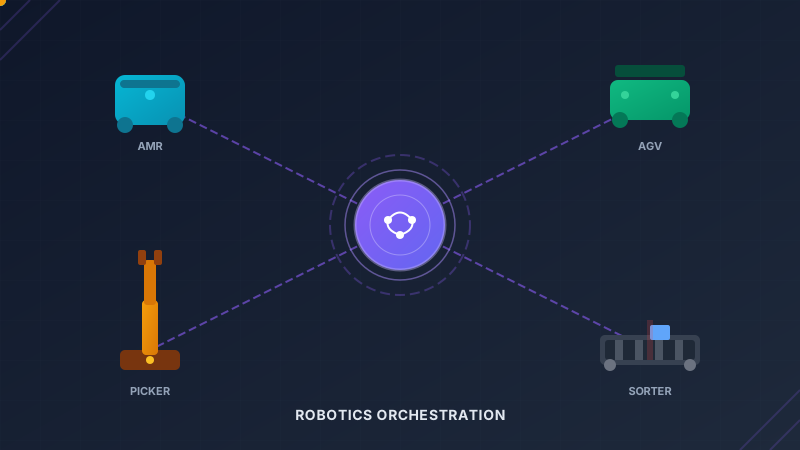
9. The Future: Robotics Orchestration

The next evolution is intelligent automation.


JASCI recognized by Gartner for robotics orchestration

AI Innovations:

  • Dynamic task allocation between humans and robots

  • Predictive maintenance

  • Continuous learning for optimization


JASCI’s ALIDA (Autonomous Labor Intelligent Dynamic Assignment) and REX (Robotics Execution System) are leading this transformation, treating robots as intelligent teammates.


Takeaway: AI turns automation into intelligence, creating self-optimizing warehouses.


10. Software First Mentality

The robots may look impressive, but projects succeed or fail because of the software. At JASCI Software, we’ve learned that complex integrations, workflow logic, and data synchronization drive true automation success, not the hardware. Software is the foundation that keeps every robot working together efficiently and intelligently.


Conclusion: Real Results, Not Experiments

The next decade of warehouse success will belong to operators who combine innovation with discipline.


At JASCI, we’ve seen that automation isn’t just about robots, it’s about people, data, and software working as one. When executed thoughtfully, robotics delivers measurable results in efficiency, safety, and scalability.


Start with what’s proven. Partner deeply. Scale smartly. That’s how the smartest warehouses are winning, and how JASCI continues to help them do it.


Comments


bottom of page